Bitcoin’s price can feel unpredictable. One day it’s rising fast, the next day it’s falling sharply. For beginners, this constant movement raises a simple but important question: how does Bitcoin price change, and why does it behave this way?
Unlike traditional currencies such as the US dollar, Bitcoin is not controlled by any government or central bank. Its price moves freely in the market, based on how many people want to buy it and how many want to sell it at any given moment. Because Bitcoin trades 24/7 worldwide, its price can change every second day or night.
This guide explains Bitcoin price changes in simple words, without technical jargon or confusing charts. You’ll learn:
- What determines Bitcoin price
- Why Bitcoin price is so volatile
- How demand, supply, and market sentiment affect it
- How news, regulations, and global events move the price
- What Bitcoin halving is and why it matters
- How beginners should think about Bitcoin in the long term
Whether you’re completely new to crypto or just curious about why Bitcoin price goes up and down so often, this article will help you understand the basics clearly and confidently so you’re not confused by daily price swings or scary headlines.
Beginners interested in building steady income can explore Passive Income Investments for Risk-Averse to learn safe strategies that minimize risk while growing wealth.
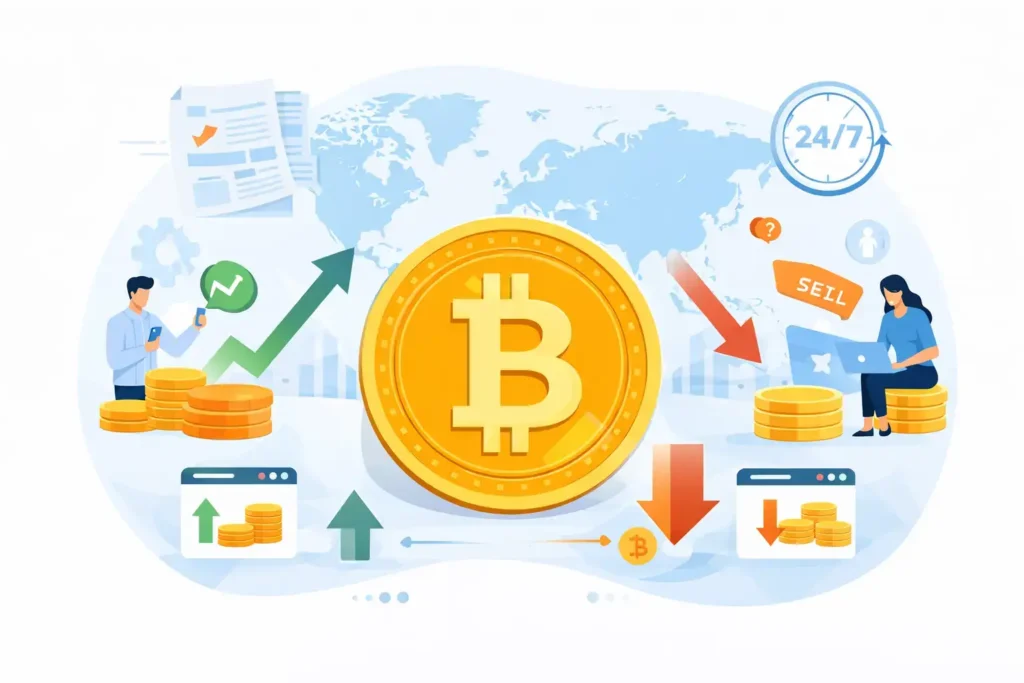
Table of Contents
- To understand how much you should set aside regularly for investing, check out How Much Should You Invest Monthly in USA for practical guidelines.
What Is Bitcoin and Why Its Price Matters
Bitcoin in simple words
Bitcoin is a digital currency that exists only online. Unlike traditional money such as the US dollar or euro, Bitcoin is not controlled by any bank or government. Instead, it operates on a decentralized network powered by computers around the world.
Every Bitcoin transaction is recorded on a public system called the blockchain, which makes the network transparent and secure.
In simple terms:
- Bitcoin = digital money
- No central authority
- Limited supply
- Runs on technology, not trust in governments
Why people care about Bitcoin price
People care about Bitcoin’s price because it affects:
- Investors trying to grow wealth
- Traders seeking short-term profits
- Businesses that accept Bitcoin
- The entire cryptocurrency market
Bitcoin is often called the leader of crypto. When Bitcoin price rises or falls, most other cryptocurrencies follow. That’s why understanding how Bitcoin price changes is so important, especially for beginners. Bitcoin – General article about Bitcoin read on Wikipedia.

How Bitcoin Price Changes (Basic Concept)
Demand vs supply explained simply
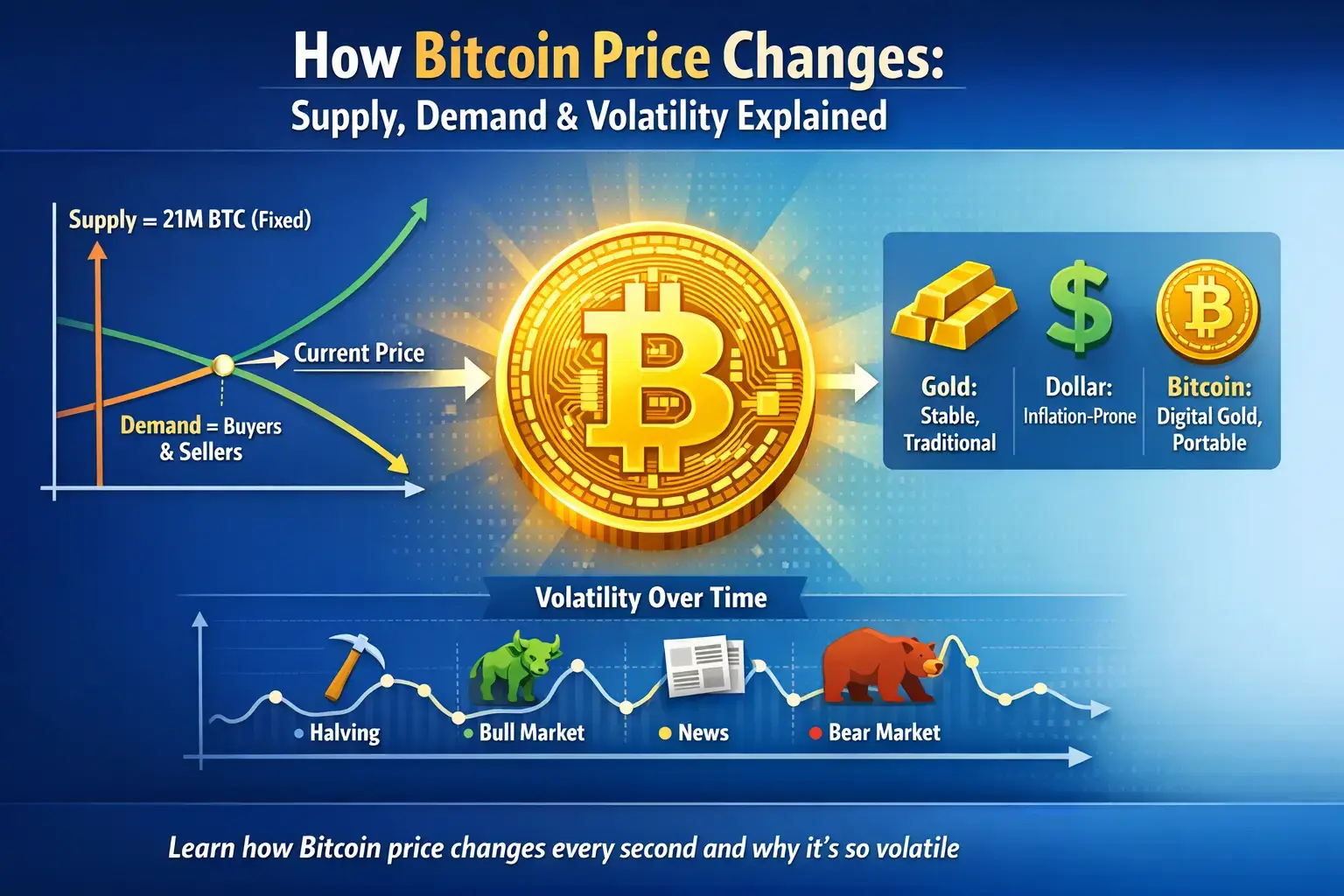
The core rule behind Bitcoin price is supply and demand.
- If more people want to buy Bitcoin than sell it → price goes up
- If more people want to sell Bitcoin than buy it → price goes down
Bitcoin has a fixed maximum supply of 21 million coins. This limited supply makes Bitcoin different from fiat currencies, which governments can print endlessly.
Because supply is limited, changes in demand have a strong impact on price.
Why Bitcoin price changes every second
Bitcoin trades 24 hours a day, 7 days a week, across global cryptocurrency exchanges. There is no closing bell like stock markets.
Every second:
- Buyers place buy orders
- Sellers place sell orders
- Exchanges match these orders
This nonstop trading is why Bitcoin price changes every second, sometimes even multiple times per second.
Who decides Bitcoin price?
No single person, company, or government decides Bitcoin’s price.
Bitcoin price is decided by:
- Buyers and sellers
- Market competition
- Global trading activity
Crypto exchanges simply show the current market price, which is the last price at which a buyer and seller agreed to trade.
What Determines Bitcoin Price
Buyer and seller behavior
Human behavior plays a massive role in Bitcoin price changes.
When people believe Bitcoin’s price will rise:
- Buyers rush in
- Demand increases
- Price moves up
When people fear losses:
- Sellers rush to exit
- Supply increases
- Price falls
Fear and optimism often matter as much as facts.
Market sentiment (fear & greed)
Bitcoin markets are driven by sentiment:
- Fear leads to panic selling
- Greed leads to aggressive buying
Tools like the “Fear and Greed Index” exist because emotions strongly influence crypto prices. For beginners, understanding this emotional cycle is crucial.
Role of exchanges
Bitcoin is traded on hundreds of exchanges worldwide. While prices may differ slightly between platforms, arbitrage traders quickly balance them.
Exchanges influence price by:
- Providing liquidity
- Matching buyers and sellers
- Reflecting real-time demand
Why Bitcoin Price Is So Volatile
Limited supply of Bitcoin
Bitcoin’s fixed supply means it reacts sharply to changes in demand. Unlike fiat currencies, Bitcoin cannot be printed to stabilize price.
Scarcity increases volatility.
Low liquidity compared to stocks
Compared to major stock markets, Bitcoin has lower liquidity. This means large buy or sell orders can move prices more dramatically.
Speculation and leverage trading
Many traders use leverage, borrowing money to trade larger positions. While leverage increases potential profits, it also:
- Increases losses
- Triggers liquidations
- Amplifies volatility
This is a major reason Bitcoin price can rise or crash quickly.
Does News Affect Bitcoin Price?
Government regulations & bans
Government actions strongly influence Bitcoin price.
Examples:
- Crypto bans often cause sharp drops
- Clear regulations often boost confidence
Because Bitcoin operates outside traditional systems, regulatory news can trigger strong reactions.
ETF approvals and institutional news
When institutions show interest in Bitcoin, prices often rise. News about:
- Bitcoin ETFs
- Corporate adoption
- Banking involvement
usually signals long-term legitimacy, increasing demand.
Social media and influencer impact
Bitcoin reacts quickly to social media. Tweets, viral posts, or influencer opinions can:
- Cause sudden price spikes
- Trigger panic selling
For beginners, it’s important to avoid trading based on hype alone.
How Bitcoin Halving Affects Price
What is Bitcoin halving?
Bitcoin halving is a scheduled event that occurs roughly every four years. During a halving:
- Mining rewards are cut in half
- New Bitcoin supply slows
This makes Bitcoin increasingly scarce over time.
Past halving events and price moves
Historically:
- Bitcoin price didn’t rise immediately after halving
- Long-term upward trends followed months later
Halving reduces supply pressure, which often supports higher prices over time.
Why halving reduces new supply
With fewer new coins entering circulation:
- Sellers have less new Bitcoin to sell
- Demand remains or increases
- Long-term price pressure moves upward
This is why halving is closely watched by investors. Bitcoin Halving – Halving events and supply impact read on Wikipedia.
Bitcoin Price History Explained (Short Overview)
Early days (2009–2013)
Bitcoin started with:
- Almost no value
- Very few users
- Experimental use
As awareness grew, Bitcoin reached its first major price milestones.
Bull and bear cycles
Bitcoin moves in cycles:
- Bull markets: rapid growth, optimism
- Bear markets: deep corrections, fear
Each cycle historically reached higher highs than the previous one.
What history teaches beginners
Bitcoin history teaches one lesson clearly:
- Volatility is normal
- Long-term patience has historically paid off
- Emotional trading often leads to losses

Bitcoin vs Gold vs Dollar: Quick Comparison
Store of Value Comparison
- Bitcoin – A digital asset that is scarce, portable, and easy to transfer worldwide. Its supply is limited to 21 million coins, making it an attractive store of value over time.
- Gold – A physical asset with thousands of years of history as a store of value. Gold is stable, widely recognized, and traditionally held by investors and governments.
- Dollar – A fiat currency controlled by central banks. Its supply can increase due to printing, making it vulnerable to inflation and reducing long-term purchasing power.
Bitcoin is often called “digital gold” because, like gold, it is scarce and can protect wealth over time. Unlike gold, it is fully digital and can be transferred globally in minutes, giving it unique advantages in the modern economy.
Volatility Difference
Bitcoin is far more volatile than traditional assets like gold or fiat currencies, especially in the short term. Volatility means how quickly and sharply an asset’s price moves up or down.
Bitcoin’s volatility is higher because:
- It has a smaller market size compared to gold or global currencies
- Trading happens 24/7 without breaks
- Prices react instantly to news, sentiment, and large trades
Gold, on the other hand, has been used for thousands of years and is widely held by governments and institutions, which makes its price movements slower and more stable. Fiat currencies such as the US dollar are backed by governments and central banks, which actively manage their supply to reduce extreme price swings.
However, Bitcoin volatility has gradually decreased over time. As adoption has grown and more institutions, funds, and long-term investors have entered the market, price movements have become more mature compared to Bitcoin’s early years. While Bitcoin is still volatile, it is less chaotic than it was a decade ago.
Inflation Impact
Fiat currencies lose purchasing power over time due to inflation. Governments regularly increase money supply to support economies, which slowly reduces the value of each unit of currency.
Bitcoin is different because:
- Its total supply is capped at 21 million coins
- No authority can print more Bitcoin
- Supply is predictable and transparent
This fixed supply makes Bitcoin attractive as a potential inflation hedge, similar to gold. When people worry about rising inflation or weakening fiat currencies, demand for Bitcoin often increases.
While Bitcoin is still volatile in the short term, many investors view it as a long-term store of value designed to protect purchasing power over time.
Can Governments Control Bitcoin Price?
Regulation vs control
Governments cannot directly control Bitcoin, but they can regulate parts of the ecosystem. Regulation influences how people access and use Bitcoin, not how the network itself operates.
Governments can regulate:
- Cryptocurrency exchanges
- Taxation of crypto profits
- Legal usage and reporting requirements
However, regulation is not the same as control. Even if exchanges are regulated, Bitcoin itself continues to operate independently.
Why Bitcoin is hard to control
Bitcoin is difficult to control because it is fully decentralized.
Bitcoin operates globally with:
- No central server
- Thousands of independent nodes worldwide
- Open-source software that anyone can verify
There is no single point of failure. Shutting down Bitcoin would require shutting down the internet worldwide, which is practically impossible. This decentralized design is one of Bitcoin’s strongest features.
What governments can influence
Although governments cannot control Bitcoin directly, they can influence:
- Market sentiment through announcements and policies
- Accessibility by regulating exchanges
- Short-term price reactions due to fear or optimism
For example, strict regulations may cause short-term price drops, while clear and supportive rules may increase confidence. Over the long term, however, Bitcoin’s price still depends on global adoption and demand, not government decisions alone.

Is Bitcoin Price Manipulated? (Myth vs Reality)
Whales and large holders
Large Bitcoin holders, often called whales, can influence short-term price movements. When a whale buys or sells a large amount of Bitcoin, it can temporarily push prices up or down.
This is more noticeable during periods of low trading volume, where fewer participants are active in the market.
Market manipulation vs free market
Short-term manipulation does exist, especially in:
- Low-liquidity periods
- Smaller exchanges
- Highly leveraged markets
However, manipulation becomes harder as the Bitcoin market grows. As market size and participation increase, it takes much more capital to move prices significantly.
In the long run, Bitcoin price trends are driven by:
- Supply and demand
- Adoption
- Network growth
Fundamentals matter more than short-term noise.
How beginners can stay safe
Beginners can reduce risk by:
- Avoiding leverage and margin trading
- Ignoring hype, rumors, and social media panic
- Focusing on education and fundamentals
A calm, informed approach helps beginners avoid emotional decisions.
Key Takeaways for Beginners
What moves Bitcoin price most
The biggest factors that move Bitcoin price are:
- Supply and demand
- Market sentiment (fear and greed)
- News, regulation, and adoption
No single factor works alone Bitcoin price changes due to a combination of all these elements.
What beginners should focus on
Beginners should focus on:
- Understanding how Bitcoin works
- Learning basic market concepts
- Managing risk instead of chasing quick profits
Knowledge is more important than timing the market.
Long-term vs short-term view
Bitcoin rewards patience more than prediction. Short-term trading is risky and emotionally stressful, especially for beginners. Long-term understanding and disciplined investing have historically produced better outcomes.
For beginners, thinking long-term reduces stress and helps avoid costly mistakes.
FAQs
Q1: How does Bitcoin price change?
Bitcoin price changes based on supply and demand on cryptocurrency exchanges.
Q2: Why does Bitcoin price change so fast?
Because Bitcoin has limited supply and trades globally 24/7.
Q3: Who controls Bitcoin price?
No one controls it buyers and sellers decide the price.
Does news really affect Bitcoin price?
Yes, major news like regulations or ETF approvals can move prices quickly.
Is Bitcoin price manipulation real?
Large investors can influence short-term moves, but long-term price follows demand.
Q6: Can Bitcoin price go to zero?
As long as Bitcoin is used and traded, its price is unlikely to be zero.
Final Thought
Understanding how Bitcoin price changes is the first step toward becoming a confident investor or crypto enthusiast. Bitcoin may seem complex and volatile at first, but at its core, its price is driven by simple economic principles: supply, demand, and human behavior.
For beginners, the key is to focus on:
- Learning how Bitcoin works
- Following long-term trends rather than short-term spikes
- Staying informed without reacting emotionally to every news headline
Bitcoin is still a young and evolving asset, and its price will continue to fluctuate. By approaching it with patience, curiosity, and a clear understanding of the factors that influence its value, you can navigate the market more confidently and make smarter decisions over time.
Remember, Bitcoin rewards knowledge and discipline more than timing the market. The better you understand what moves its price, the better positioned you are to make thoughtful, long-term decisions.
- Calculate your expected take-home pay after taxes quickly using the Salary Paycheck Calculator 2026.
- See how your investments can grow over time with interest compounding by trying our Compound Interest Calculator.