
What Is a Credit Score and How Does It Work?
A credit score is one of the most powerful numbers in your financial life. It silently controls whether you qualify for loans, credit cards, apartments, and even some jobs. Yet millions of people still don’t fully understand what is a credit score and how does it work.
Your credit score (what is a credit score and how does it work) is a three-digit number that summarizes your financial trustworthiness. Banks, lenders, landlords, and even insurance companies use it to judge how responsibly you handle money.
A strong credit score opens doors to low interest rates and premium financial opportunities. A weak score can cost you thousands of dollars in extra interest over your lifetime.
That is why learning the credit score meaning and mastering your credit profile is essential for long-term financial success.

Table of Contents ( What Is a Credit Score and How Does It Work )
Definition of a Credit Score (What Is a Credit Score and How Does It Work?)
The official credit score definition is:
A credit score is a numerical representation of your credit risk based on your borrowing and repayment history.
In simple words, it answers one question:
Can this person be trusted to repay money?
Credit scores usually range from 300 to 850. The higher your number, the safer you look to lenders.
How Credit Scores Work
Many people ask, how do credit scores work in real life?
Your credit score works like a financial reputation system. Every time you:
- Pay a bill
- Use a credit card
- Apply for a loan
Your actions are recorded on your credit report. Scoring models analyze this data and update your score.
This is why understanding how credit scores work for loans is critical. A good score can save you huge amounts in interest, while a poor score makes borrowing expensive or impossible.
How Your Credit Score Is Calculated
If you wonder what is a credit score and how is it calculated, the answer lies in your credit report.
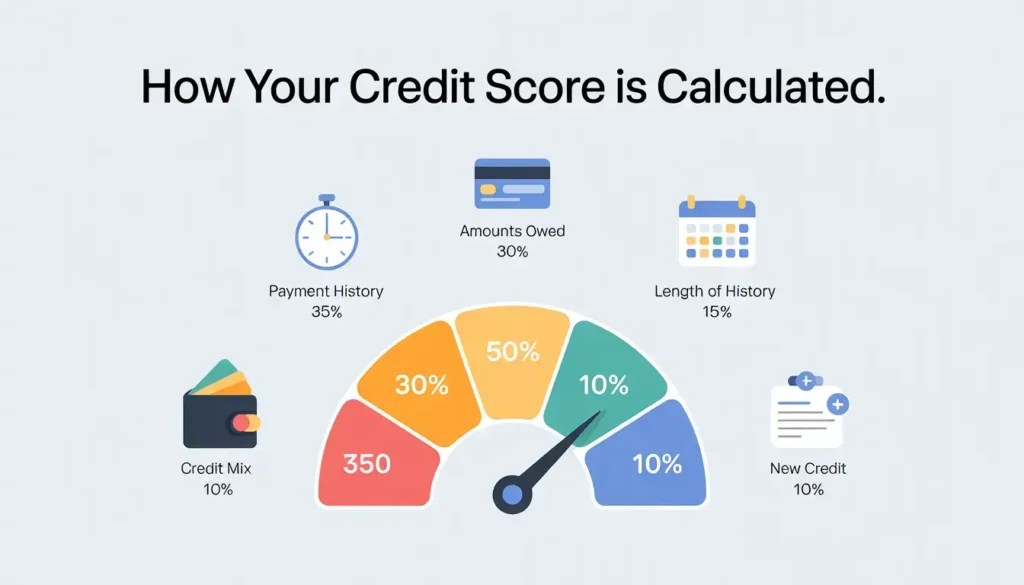
Your credit score calculation is based on five core factors.
Factors That Impact Your Credit Score
These are the factors that affect your credit score the most.
Payment History (35%)
Payment history is the most powerful factor. One missed payment can hurt your score for years.
Lenders believe:
Past behavior predicts future behavior.
Amounts Owed (30%)
This measures how much of your available credit you use. This is called credit utilization.
High balances signal financial stress and reduce your score.
Length of Credit History (15%)
A longer history shows experience and stability. Old accounts help your score even if you no longer use them often.
Types of Credit (10%)
A mix of credit cards, auto loans, and personal loans improves your profile.
New Credit (10%)
Too many applications in a short time make lenders nervous and lower your score.
VantageScore vs FICO Score
Understanding FICO score vs VantageScore is important because both are used widely.
FICO Score Explained
The FICO score is used by over 90% of major lenders. It strongly prioritizes payment history and debt levels.
VantageScore Explained
VantageScore was created by the three credit bureaus. It can score people with shorter credit histories and uses slightly different weightings.
This explains the difference between FICO score and VantageScore when you see different numbers on different platforms.
What Is a Good Credit Score to Have?
So, what is considered a good credit score?
Credit Score Ranges (Excellent, Good, Fair, Poor)
| Range | Rating |
|---|---|
| 800–850 | Excellent |
| 670–799 | Good |
| 580–669 | Fair |
| 300–579 | Poor |
A good credit score range begins at 670.
Who Calculates Credit Scores?
Credit scores are generated using data from three major bureaus:
- Experian
- Equifax
- TransUnion
These bureaus collect your financial history and share it with scoring companies.
What Is a Credit Score Used For?
Your credit score is used for:
- Loan approvals
- Credit card limits
- Mortgage rates
- Apartment rentals
- Insurance pricing
This is exactly how lenders use credit scores to protect their money.
How Lenders Calculate Your Credit Score
Lenders review your score to estimate risk. Higher scores mean safer borrowers, which leads to:
- Lower interest rates
- Higher loan limits
This proves why your credit score is important for financial life.
How Is a Credit Score Graded?
Your credit score is not chosen randomly. It is produced by advanced statistical models that analyze your financial behavior and compare it with millions of other borrowers.
Credit scoring systems study patterns such as:
- Who repays loans on time
- Who defaults or misses payments
- How much debt people successfully manage
Based on this data, the model predicts the likelihood that you will miss a payment in the future. The higher your score, the lower your predicted risk.
This grading system allows lenders to:
- Approve reliable borrowers faster
- Charge higher interest to risky borrowers
- Protect themselves from financial losses
This is a key part of how lenders use credit scores to price loans fairly and reduce default risk.
How to Improve Your Credit Score
Learning how to improve your credit score fast is one of the most valuable personal finance skills you can develop. A higher credit score can save you thousands of dollars through lower interest rates on mortgages, car loans, and credit cards.
Improving your credit score is not about shortcuts. It is about building consistent financial habits that show lenders you are responsible with money.
The good news is that even small changes can start increasing your credit score (What Is a Credit Score and How Does It Work)within a few months.
Tips to Boost Credit Score Fast
These proven strategies focus on the biggest factors in credit score calculation (What Is a Credit Score and How Does It Work).
Pay bills before the due date
Payment history makes up 35% of your credit score. Even one late payment can drop your score significantly. Setting reminders or autopay ensures perfect payment records.
Reduce credit card balances below 30%
This improves your credit utilization ratio. Lower balances instantly make you look less risky to lenders.
Keep old accounts open
Length of credit history improves trust. Old accounts increase your average account age, which strengthens your credit profile.
Avoid unnecessary applications
Too many hard inquiries in a short time signals financial stress and can reduce your score.
Check your credit report for errors
Mistakes such as incorrect late payments or unknown accounts can unfairly lower your score. Disputing errors can result in rapid improvements.
These actions directly support how to improve your credit score fast (What Is a Credit Score and How Does It Work?)in a safe and sustainable way.

- If you are planning to borrow money soon, check out our detailed article on credit card vs debit card differences to choose the right payment method.
Common Credit Score Mistakes
Many people damage their credit score without realizing it. Avoid these high-risk ( in What Is a Credit Score and How Does It Work)behaviors:
Late payments
Even a 30-day late payment can remain on your report for seven years.
Maxed-out credit cards
High balances make lenders think you rely too heavily on debt.
Closing old accounts
This shortens your credit history and can increase utilization ratios.
Ignoring your credit report
Undetected fraud or reporting errors can silently destroy your score.
These mistakes weaken your credit profile quickly and make borrowing more expensive.
How Can I Impor My Credit Score Quickly?
If you need fast improvement, focus on the highest-impact actions:
Pay down balances immediately
Lower utilization can boost your score within one or two billing cycles.
Use automatic payments
Prevents late payments and protects your payment history.
Become an authorized user
Being added to a well-managed, old credit card account can rapidly strengthen your credit history.
These strategies are the most effective answers to how to raise your credit score quickly.
Where Can I Get My Credit Score?
Many people ask, where can I check my credit score for free?
You can access your score from:
- Banks and mobile banking apps
- Credit card companies
- Credit bureaus
These services provide free access because educated consumers are better borrowers for What Is a Credit Score and How Does It Work.
Checking Your Credit Score
Checking your own credit score does not hurt it. This is known as a soft inquiry, and it has no impact on your rating.
Regular monitoring helps you:
- Track improvement progress
- Spot identity theft early
- Correct reporting errors
Smart borrowers treat their credit score ( What Is a Credit Score and How Does It Work ) like a financial health checkup.
Why Your Credit History Matters
Your credit history reflects your long-term financial discipline. It tells lenders how you manage obligations over time.
- Strong history = trust and lower interest rates
- Weak history = higher risk and higher borrowing costs
This is exactly why your credit score ( What Is a Credit Score and How Does It Work ) is important for financial life.

After learning about credit scores, you may also want to read our guide on saving money strategies to improve your overall financial health.
FAQs
What is a credit score and how does it work?
A score ( What Is a Credit Score and How Does It Work ) is a three-digit number that shows how trustworthy you are as a borrower. It works by analyzing your credit history and predicting how likely you are to repay future debts. Lenders use this score to decide whether to approve loans and what interest rate to offer.
What is considered a good credit score?
A good credit score range is usually between 670 and 799. Scores above 800 are excellent, while scores below 580 are considered poor.
What is a score and how is it calculated?
A credit score is calculated using information from your credit report. The main factors include payment history, amounts owed, length of credit history, types of credit, and new credit activity. This process is known as credit score calculation for ( What Is a Credit Score and How Does It Work ).
How does a credit score work for loans?
When you apply for a loan, lenders check your score to judge risk. Higher scores mean lower risk, which leads to better approval chances and lower interest rates. Lower scores mean higher risk and more expensive loans.
What affects your credit score the most?
The biggest factor is payment history, which makes up 35% of your score. Late payments, defaults, and collections cause the most damage. Credit card balances are the second most important factor.
What is the difference between FICO score and VantageScore?
The difference between FICO score and VantageScore is in how they weigh credit data. FICO is used by most lenders, while VantageScore may score people with shorter credit histories differently. Both aim to predict credit risk in ( What Is a Credit Score and How Does It Work ).
Conclusion
Understanding what is a credit score and how does it work is one of the most powerful financial skills you can develop. Your credit score ( What Is a Credit Score and How Does It Work ) is not just a number it is a financial reputation that follows you throughout life.
From loan approvals to interest rates, your credit score affects nearly every major financial decision. A strong score gives you access to cheaper credit, better housing options, and greater financial freedom. A weak score makes everything more expensive and difficult.
By learning the true credit score meaning, understanding credit score calculation, and applying smart habits such as paying on time, lowering balances, and monitoring your report, you can steadily improve your financial standing.
No matter where you start, your credit score can always be improved. Consistency, patience, and discipline will transform your score and your financial future.
To understand the technical meaning of a credit score, you can also read the detailed explanation on ( What Is a Credit Score and How Does It Work ) on Wikipedia.