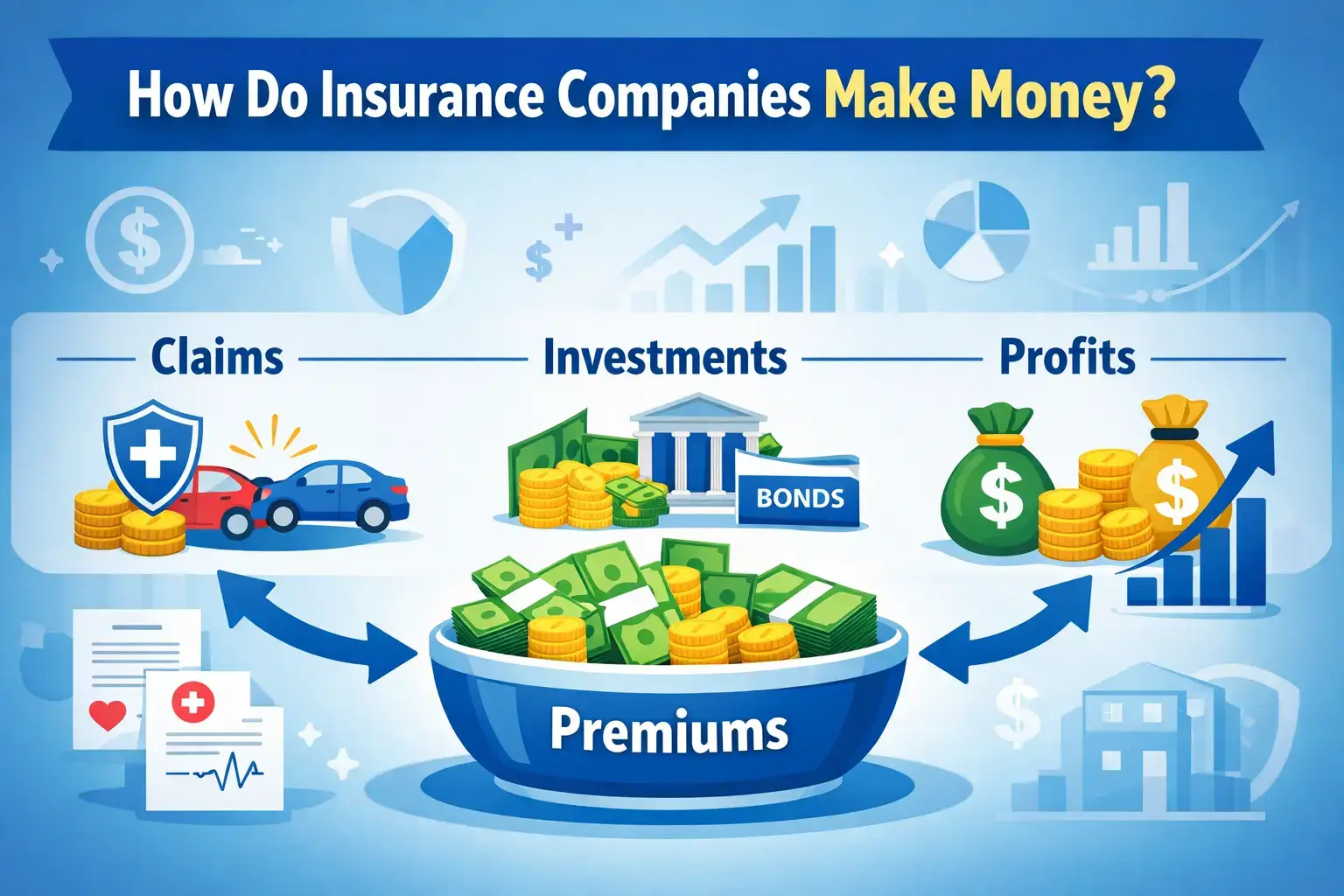
How do insurance companies make money?
It’s a simple question with a surprisingly powerful answer—and one that matters whether you’re buying insurance, studying finance, or thinking like an investor.
At a basic level, insurance companies make money by collecting premiums, managing risk, and investing those premiums wisely. But the real business model goes much deeper than “premiums in, claims out.” Insurers survive recessions, natural disasters, and market crashes not by luck, but through carefully designed systems built on math, probability, regulation, and long-term investing.
In this beginner-friendly guide, you’ll learn exactly how insurance companies make money, step by step, without confusing jargon. We’ll explain how premiums work, what underwriting really means, why insurers invest billions in bonds, how reinsurance protects them from disasters, and how investors evaluate insurance companies financially.
Readers interested in the business and investment side of finance may also find value in our detailed comparison of CA vs ACCA vs CFA and which qualification is better worldwide in 2026, especially when analyzing insurance companies as long-term investments.
Table of Contents
How the Insurance Business Model Works
Before we talk about profits, it’s important to understand what insurance companies actually sell.
What insurers actually sell (risk transfer explained simply)
Insurance companies don’t sell “policies” in the way stores sell products.
They sell risk transfer.
When you buy insurance, you’re paying a company to take on a financial risk you don’t want to carry alone such as a car accident, house fire, medical emergency, or death.
Simple example (auto insurance):
- You pay $1,500 per year in premiums
- The insurer promises to pay covered accident costs if something happens
- Most years, you file no major claim
- A small percentage of policyholders have expensive accidents
The insurer’s job is to predict how often losses will happen and how much they’ll cost, then price premiums so total money collected exceeds total money paid—over time.
Why Many People Pay So a Few Can Claim: The Power of Risk Pooling
At its core, insurance works through a concept called risk pooling, which is central to how insurance companies make money. Instead of one individual bearing the full cost of a disaster or accident, many people share the financial burden. This principle allows insurance companies to stay profitable while protecting policyholders. Understanding this concept is essential for beginners who want to know how insurance companies make profit and how premiums are priced.
How Risk Pooling Works
Premiums from Many, Claims from Few
Millions of policyholders pay relatively small, predictable premiums. Only a small fraction actually experiences a loss in any given year.
Example:
- Imagine an auto insurer with 1 million drivers
- Only 50,000 drivers file major claims in a year
- Premiums collected from all 1 million drivers cover the losses of those 50,000
This explains part of how insurance companies make money: by collecting more in premiums than they pay out in claims.
Predictable Patterns Across Large Groups
While accidents and disasters are unpredictable for an individual, they become statistically predictable across thousands or millions of policyholders. Insurers rely on actuarial models and historical data to estimate average losses. This is a key component of the insurance company business model explained for beginners.
The Law of Large Numbers
A fundamental principle in insurance is the law of large numbers.
- Small pool (10 drivers): A single accident could bankrupt the insurer.
- Large pool (1 million drivers): One accident barely impacts the overall financial pool.
By insuring a large group, insurance companies reduce uncertainty and stabilize profits, which is a major reason insurance companies are profitable over time.
Premium Pricing Reflects Risk
To keep the risk pool sustainable, insurers price premiums according to expected risk:
- Low-risk individuals pay lower premiums
- High-risk individuals pay higher premiums
This ensures the pool covers claims while generating underwriting profit, another way insurance companies make money.
Diversification Across Policies and Regions
Insurance companies also diversify risk across products and locations:
- Auto, home, life, and health insurance
- Geographical diversity: A hurricane in Florida may increase claims, but policies in other regions stabilize the portfolio
Diversification is part of insurance risk management explained, helping insurers survive disasters and maintain steady profits.
Premiums, Pricing, and Risk Assessment
Premiums are the engine of the insurance business model.
How insurance premiums are calculated
Insurance premiums aren’t random. They’re based on actuarial science, historical data, and probability.
Insurers analyze factors like:
- Age, location, and behavior (for auto or health insurance)
- Property value and weather risk (for home insurance)
- Occupation and health history (for life insurance)
Basic pricing idea:
Expected claims
- operating expenses
- safety margin
= premium
If an insurer expects $800 in claims and $400 in expenses per policy, premiums must exceed $1,200 to be profitable.
Why higher risk means higher premiums
Higher risk equals higher expected claims.
For example:
- A safe driver might pay $1,200 per year
- A high-risk driver might pay $3,000 per year
The insurer isn’t being unfair—it’s aligning price with probability. If premiums didn’t reflect risk, low-risk customers would subsidize high-risk ones and eventually leave.
What underwriting means
Underwriting is the process of deciding:
- Who to insure
- At what price
- Under what conditions
Underwriters assess risk and determine whether the premium adequately covers it.
In plain terms:
Underwriting = deciding if the bet is worth taking
Good underwriting is one of the biggest reasons insurance companies make money long-term.
Underwriting Profit vs Investment Income
Insurance companies earn money in two main ways, not one.
What is underwriting profit?
Underwriting profit happens when:
Premiums collected
− claims paid
− operating expenses
= positive number
If an insurer collects $10 billion in premiums and pays $9.5 billion in claims and expenses, it earns $500 million in underwriting profit.
This is the pure insurance profit, before investments.
What happens when claims exceed premiums?
Sometimes, claims and expenses exceed premiums. This results in an underwriting loss.
Here’s the key insight most beginners miss:
Insurance companies can still be profitable even with underwriting losses.
How? Investment income.
Why investment income matters for insurers
Insurance companies don’t sit on premium cash. They invest it—often for years—before claims are paid.
This creates what’s known as the insurance float.
The float is money the insurer holds temporarily but doesn’t yet own. While holding it, the insurer earns returns.
Even modest returns on massive sums can generate billions in profit.
How Insurance Companies Invest Premiums
Investment income is a critical part of how insurance companies make money.
Where insurers invest their money (bonds, Treasuries, equities)
Because insurers must be able to pay claims at any time, they prioritize safety and liquidity.
Common investments include:
- U.S. Treasuries
- Investment-grade corporate bonds
- Municipal bonds
- Limited exposure to equities
- Short-term cash instruments
Regulators closely monitor these investments, often under frameworks influenced by organizations like the National Association of Insurance Commissioners.
How interest rates impact insurance profits
Interest rates have a huge impact on insurance company profitability.
- Low rates → lower investment income
- High rates → higher bond yields and profits
When interest rates rise, insurers can reinvest premiums at better returns, boosting long-term earnings—even if underwriting results stay flat.
Why insurers prefer low-risk investments
Unlike hedge funds, insurers can’t afford large investment losses. Claims must be paid regardless of market conditions.
That’s why insurers:
- Focus on capital preservation
- Match investment durations to expected claims
- Avoid excessive volatility
This conservative approach is why insurance companies tend to survive financial crises better than many other financial institutions.

How Reinsurance Helps Insurance Companies Manage Risk
One of the most misunderstood parts of the insurance business model is reinsurance.
What reinsurance is (insurance for insurers)
Reinsurance is exactly what it sounds like: insurance companies buying insurance for themselves.
If an insurer underwrites a large amount of risk, it may transfer part of that risk to a reinsurance company in exchange for a premium.
This helps limit catastrophic losses.
Why reinsurance is critical during disasters
Natural disasters can generate enormous claims:
- Hurricanes
- Wildfires
- Earthquakes
Without reinsurance, a single major disaster could bankrupt an insurer. Reinsurance spreads losses globally across many companies and regions.
This is one reason insurers don’t collapse when “everyone files claims at once.”
How reinsurance stabilizes profits
Reinsurance allows insurers to:
- Smooth earnings over time
- Take on more policies safely
- Protect capital during extreme events
While reinsurance reduces some profit (because insurers pay premiums to reinsurers), it dramatically lowers existential risk.
Here’s a clear breakdown and explanation of the sections you provided, so it’s easier to understand how each part relates to assessing financial health and profitability in insurance companies:
How to Assess the Financial Health of Insurance Companies
When investors look at insurance companies, they don’t just check stock prices—they examine specific metrics that reveal profitability, efficiency, and risk management.
Insurance companies earn money from two main sources:
- Underwriting profit – the difference between premiums collected and claims/expenses paid.
- Investment income – returns earned by investing premiums before claims are paid.
Metrics and ratios give investors a snapshot of both.
2. Combined Ratio: What It Tells Investors
Definition: The combined ratio is a key measure of an insurer’s underwriting performance.
Formula:Combined Ratio=PremiumsClaims + Expenses
Interpretation:
- Below 100% → underwriting profit (premiums cover claims and expenses)
- Above 100% → underwriting loss (claims/expenses exceed premiums)
Example:
A combined ratio of 95% means the company keeps $0.05 for every $1 in premiums after paying claims and expenses.
This is purely from the insurance side, excluding investment income.
3. Loss Ratio vs Expense Ratio
The combined ratio is composed of two parts:
- Loss ratio – proportion of premiums paid out in claims. Loss Ratio=PremiumsClaims
- Expense ratio – proportion of premiums spent on operating costs. Expense Ratio=PremiumsOperating Costs
Why it matters:
Analyzing both shows whether a problem is due to:
- Too many claims (loss ratio)
- Inefficient operations (expense ratio)
- Or mispricing of risk
4. Why Reserves and Estimates Matter
Insurance companies set aside reserves to cover future claims that haven’t been reported yet.
- Under-reserving → profits appear higher than they really are, creating future shortfalls.
- Conservative reserving → indicates strong management and long-term stability.
Investors look at reserve adequacy to gauge the company’s financial health and its ability to survive unexpected losses.

Key Financial Ratios Used to Value Insurance Stocks
Unlike tech companies, insurance companies rely heavily on balance sheet health and profitability ratios.
a) Price-to-Earnings (P/E) Ratio
Definition:P/E=Earnings per ShareStock Price
- Low P/E: stock may be undervalued
- High P/E: market expects strong growth
Insurance earnings can fluctuate with claims cycles, so P/E is more meaningful over several years, not just quarterly.
b) Price-to-Book (P/B) Ratio
Definition:P/B=Book Value per ShareMarket Price
- Compares market valuation to actual assets on the balance sheet.
- P/B below 1 → stock may be undervalued
- P/B above 1 → investors expect high returns
Because insurers hold large investments and reserves, their book value is crucial in assessing value.
c) Return on Equity (ROE)
Definition:ROE=Shareholder EquityNet Income
What it indicates:
- Efficiency in using shareholder capital
- High ROE over time → strong underwriting, smart investing, and good capital management
Challenges and Risks in the Insurance Industry
Even established insurers face risks:
a) Climate Risk and Rising Claims
- Natural disasters and climate change increase both the frequency and severity of claims.
- Companies may need to:
- Raise premiums
- Exit high-risk areas
- Adjust underwriting standards
b) Pricing Mistakes and Under-Reserving
- Underpricing risk or underestimating future claims leads to long-term losses.
- Mistakes often appear slowly, making management discipline essential.
c) Regulation and Market Cycles
- U.S. insurance is state-regulated, limiting flexibility.
- Regulatory constraints can:
- Delay premium increases
- Limit profitability during inflation or market swings
Is the Insurance Business Profitable Long-Term?
Yes, but profitability depends on disciplined underwriting, risk management, and investing.
Why Insurers Survive Economic Downturns
- Insurance demand is inelastic: people always need auto, home, health, and life coverage.
- Premium income remains relatively stable, even during recessions.
Most Profitable Insurance Sectors
| Sector | Profitability Traits |
|---|---|
| Property & Casualty | Cyclical but high-margin during good years |
| Life Insurance | Long-term profits from premiums invested over decades |
| Health Insurance | Stable cash flow but heavily regulated |
Diversification across sectors reduces risk and smooths earnings.
Bottom Line:How Do Insurance Companies Make Money?
Insurance companies master three key levers to stay profitable:
- Accurate underwriting – price risk correctly to earn premiums above claims.
- Efficient claims and expense management – control costs and process claims efficiently.
- Conservative investing of premiums – generate returns on the float without taking excessive risk.
Premiums are the foundation, but scale, data, discipline, and long-term investment strategy drive the real profits.
Understanding this model is crucial for policyholders evaluating coverage and investors analyzing insurance stocks.
FAQs:How Do Insurance Companies Make Money?
How do insurance companies make money?
Insurance companies primarily earn money from premiums collected from policyholders and by investing those premiums before paying claims.
What is underwriting profit in insurance?
Underwriting profit occurs when premiums collected exceed claims and operating expenses. It reflects the core profitability of the insurance business.
Do insurance companies make money if no one files claims?
Yes. Unused premiums contribute to underwriting profit, and invested premiums generate investment income, both adding to company profits.
What is reinsurance and why is it important?
Reinsurance is insurance for insurance companies. It protects insurers from large or unexpected losses, especially during disasters or high claims years.
What does a combined ratio below 100% mean?
A combined ratio below 100% indicates the insurer is profitable from underwriting alone, before considering investment income.
Are insurance companies good long-term investments?
Many insurers can be stable long-term investments, but profitability depends on underwriting discipline, investment returns, and risk management.

For a foundational definition and historical background, you can also review the explanation of insurance on Wikipedia, which provides an overview of how insurance systems work globally.
If you’re new to personal finance and credit systems, our complete beginner guide on what a student credit card is and how to apply for one safely in 2026 explains how financial institutions manage risk and profitability at an individual level.