The future of Chartered Accountants in AI is rapidly transforming the accounting profession in the USA, creating both challenges and opportunities for finance professionals. While some ask, “Will AI replace Chartered Accountants?”, the reality is far more nuanced. AI is automating routine bookkeeping, reconciliations, and auditing tasks, but human expertise, professional judgement, and ethical oversight remain indispensable. For beginners exploring AI in accounting, understanding accounting automation tools in the USA, adapting to new roles, and strategically upskilling are essential to thrive in accounting jobs in 2026. Chartered Accountants who embrace AI can unlock career opportunities, increase operational efficiency, and strengthen their role as trusted advisors in businesses.
In today’s fast-changing financial environment, accounting jobs in 2026 will look very different from traditional roles. Tasks such as data entry, invoice processing, and basic reconciliations are increasingly handled by AI and automation tools, freeing CAs to focus on strategic decision-making, financial analysis, and client advisory services. This shift opens up exciting Chartered Accountant career opportunities, including positions as AI integration specialists, auditing experts, and data analytics professionals—roles that combine technical skills with human judgment.
Personal Finance Guide – “Understand the basics by reading our personal finance guide.”
Table of Contents of Future of Chartered Accountants in AI
Understanding Future of Chartered Accountants in AI
Artificial intelligence is no longer just a futuristic concept it is actively transforming the accounting profession. For Chartered Accountants (CAs) in the USA, understanding AI is no longer optional; it is essential for staying relevant and competitive. To fully grasp its impact, it’s important to know what AI is, how it’s applied in finance, and the types of AI technologies reshaping the industry.
What is AI and How It’s Used in Finance
AI refers to computer systems capable of performing tasks that typically require human intelligence, such as learning, problem-solving, and decision-making. In accounting, AI is applied to automate repetitive tasks, analyze vast amounts of data, and enhance decision-making. Key applications include:
- Automating data entry and transaction processing – AI tools can extract invoice details, categorize transactions, and update ledgers automatically, reducing human error.
- Predictive analytics for cash flow forecasting – AI analyzes historical trends to predict future revenues, expenses, and liquidity needs, helping businesses plan proactively.
- Anomaly detection in auditing to identify fraud – AI flags unusual patterns in transactions that might indicate errors or fraudulent activity.
- Natural language processing for document review – AI can read and summarize contracts, financial statements, and compliance documents, speeding up review processes.
For beginners exploring AI in accounting, these tools mean less time spent on manual work and more opportunity for strategic financial analysis and client advisory services. Platforms like Microsoft Power Automate and GenAI CoPilot are already streamlining workflows in US accounting firms, showing how AI can complement, rather than replace, human expertise.
Types of AI: Machine Learning, RPA, and GenAI
Understanding the different types of AI helps CAs identify where their skills are most valuable:
- Machine Learning (ML):
ML uses algorithms to analyze historical data and make predictions about future trends.- Example: Forecasting quarterly tax liabilities or projecting cash flow for a small business.
- Robotic Process Automation (RPA):
RPA automates repetitive accounting processes such as accounts payable invoice entry, payroll processing, or bank reconciliations.- Benefit: Reduces errors, increases efficiency, and frees accountants for higher-value work.
- Generative AI (GenAI):
GenAI creates reports, summaries, and actionable insights from large datasets, enabling faster and more informed decision-making.- Example: Generating quarterly financial dashboards automatically with visual analytics for management review.
By integrating these AI technologies, accountants can handle high-volume, data-intensive tasks faster while dedicating more time to strategic planning, client advisory, and ethical decision-making. This combination of human judgment and AI-powered efficiency defines the modern role of Chartered Accountants in 2026 and beyond.ntants can significantly increase efficiency while reducing human error.
How AI Is Changing the Role of Chartered Accountants
AI is not just a tool; it is transforming how CAs work and the skills they need to stay competitive.
Automating Routine Tasks: AP Data Entry, Reconciliations, Bookkeeping
AI automates manual processes that historically consumed hours:
- AP and AR data entry: AI extracts invoice information and posts transactions accurately.
- Bank reconciliations: AI matches transactions with minimal human intervention.
- Bookkeeping: Automated categorization reduces manual errors.
Example: A mid-sized US firm using RPA reduced AP processing time by 70%, freeing accountants to focus on client strategy.
Data Analysis and Predictive Insights
AI-driven analytics enable accountants to provide forward-looking insights:
- Forecasting revenue and expenses
- Identifying trends in client spending
- Optimizing tax strategies using historical data
Simple calculation example: If a business expects $120,000 in revenue with a 10% month-on-month growth, AI can project next quarter revenue as $120,000 × (1 + 0.10)^3 ≈ $159,720.
Streamlined Audits and Fraud Detection
AI enhances audit quality by detecting anomalies faster:
- Real-time transaction analysis for fraud patterns
- Highlighting irregularities in compliance reporting
- Generating audit trails automatically for regulators
According to ACCA insights, firms leveraging AI for auditing reported 50% faster audit cycles while maintaining accuracy.
The Importance of Professional Judgement
Despite automation, human judgement remains irreplaceable in finance.
Why Human Expertise Cannot Be Replaced by AI
AI handles structured tasks but cannot:
- Interpret complex financial contexts
- Make strategic business decisions
- Adapt to unexpected regulatory changes
Example: Choosing between multiple tax strategies requires understanding client-specific risk tolerance—something AI cannot decide.
Ethical Decision-Making and Transparency
Accountants ensure that financial reporting adheres to legal and ethical standards:
- AI outputs must be verified for accuracy
- Transparency in AI-driven recommendations is critical
- Ethical oversight ensures fairness and regulatory compliance
Case Study: ACCA’s AI Monitor Insights
ACCA’s AI Monitor reported that firms adopting AI still rely heavily on CAs for:
- Reviewing AI-generated reports
- Guiding clients on complex compliance issues
- Advising on strategic financial decisions
This proves that AI augments rather than replaces human expertise.
Emerging Roles for Chartered Accountants in 2026
As AI reshapes the accounting landscape, it is also creating exciting new career pathways for Chartered Accountants (CAs) who are willing to embrace technology. Rather than being replaced, accountants can leverage AI to expand their roles into higher-value areas that combine technical skills, strategic insight, and professional judgment.
1. AI Integration and Implementation Specialists
CAs in this role focus on bridging the gap between traditional accounting and modern AI systems. Responsibilities include:
- Designing AI workflows: Implementing tools like Robotic Process Automation (RPA) to automate repetitive tasks such as accounts payable, payroll processing, and bank reconciliations.
- Training staff on AI adoption: Ensuring finance teams understand how to use AI tools effectively and responsibly.
- Monitoring AI performance: Regularly reviewing AI outputs for accuracy, efficiency, and compliance with accounting standards.
Example: A mid-sized US accounting firm may hire a CA integration specialist to implement AI that automatically reconciles 10,000+ transactions monthly, reducing manual errors while freeing staff for analysis and client advisory.
2. AI Auditing Experts
AI is transforming audit processes, and CAs can specialize in AI-driven auditing to add significant value:
- Specializing in automated audits: Using AI to analyze large volumes of transactions, identify anomalies, and detect potential fraud.
- Ensuring regulatory compliance: Reviewing AI-generated audit outputs to ensure they meet GAAP, IRS standards, or other regulatory requirements in the USA.
- Combining traditional expertise with AI insights: While AI handles data processing, CAs provide the judgment necessary to interpret results and make strategic recommendations.
Example: An AI auditing expert may use machine learning to flag unusual transactions across hundreds of client accounts, then provide insights to management for investigation and corrective action.
3. Data Analytics and Visualization Professionals
Modern accounting is no longer just about numbers—it’s about turning data into actionable insights. CAs who master analytics and visualization can become indispensable advisors:
- Translating complex datasets: Transforming raw financial data into understandable charts, dashboards, and reports for stakeholders.
- Using tools like Power BI, Tableau, and Excel with AI add-ons: Creating interactive dashboards that reveal trends, forecasts, and risks.
- Communicating insights effectively: Presenting AI-generated insights to management, investors, or clients in a clear, strategic, and actionable way.
Example: A CA using Power BI could combine AI-predicted cash flow data with historical performance to recommend budget adjustments, helping a company avoid liquidity issues.
Key Takeaway: In 2026, Chartered Accountants are no longer just number-crunchers—they are strategic advisors, AI specialists, and data interpreters. By embracing these emerging roles, CAs can future-proof their careers and remain highly relevant in an AI-driven finance world.
Creating a Personal Budget – “Learn how to manage your money month-to-month with creating a personal budget step by step.”
Upskilling for the AI Era ( Future of Chartered Accountants in AI )
Adapting to AI requires targeted upskilling in technical and soft skills.
Digital Literacy: Power BI, RPA, AI Tools
CAs must be comfortable with:
- Power BI: For real-time financial dashboards
- RPA platforms: Automating repetitive accounting tasks
- GenAI tools: Drafting financial reports and insights
Soft Skills: Critical Thinking, Communication, Ethical Oversight
AI cannot replicate:
- Ethical reasoning
- Negotiation with clients
- Explaining complex insights in simple terms
These skills distinguish high-value accountants in the AI era.
Learning Resources and Certifications
- ACCA’s AI-focused modules
- CPA courses with AI/automation integration
- Online platforms: Coursera, Udemy, and LinkedIn Learning for AI in accounting
Challenges and Considerations:Future of Chartered Accountants in AI
While AI brings efficiency, speed, and accuracy to accounting, Chartered Accountants (CAs) face several challenges. These aren’t just technical they’re about jobs, ethics, and leadership.
1. Job Displacement vs Role Evolution
- What it means: AI can automate repetitive accounting tasks such as data entry, bookkeeping, and basic reconciliations. Because of this, some traditional accounting roles may shrink or disappear over time.
- Impact: For example, a junior accountant who spends hours reconciling bank statements might see that task handled automatically by AI. This could reduce demand for purely manual bookkeeping jobs.
- Opportunity: While some jobs decline, strategic and advisory roles grow. CAs can shift from doing repetitive tasks to providing value-added insights—like helping businesses forecast cash flow, plan budgets, or advise on tax strategies.
- Bottom line: AI changes what accountants do, not necessarily whether they have a career. Roles evolve rather than vanish.
2. AI Biases and Data Security
- AI Bias: AI systems make predictions based on historical data. If the data is flawed or biased, the AI’s outputs can be inaccurate.
- Example: If an AI predicts which invoices might be delayed using only past late payments from certain clients, it may unfairly flag clients incorrectly, creating errors or conflicts.
- Data Security: Accounting involves sensitive financial information. Using AI tools without proper security measures can risk exposing client data to cyberattacks or misuse.
- Takeaway: CAs must ensure AI predictions are validated and client data is always protected.
3. Leadership and Continuous Learning Gaps
- Leadership: Firms need managers who understand AI capabilities and can integrate them responsibly into workflows. Without strong leadership, AI adoption can fail or create inefficiencies.
- Continuous Learning: Technology evolves quickly. CAs must continuously upskill—learning new AI tools, analytics platforms, and automation software. Firms with a strong learning culture stay competitive; those without may fall behind.
Future of Chartered Accountants in AI
| Aspect | Traditional CA Roles | Emerging AI-Era CA Roles (2026) |
|---|---|---|
| Primary Focus | Manual bookkeeping, data entry, reconciliations | Strategic advisory, AI integration, data-driven insights |
| Routine Tasks | Accounts payable/receivable, payroll processing, bank reconciliations | Automated via AI/RPA; CAs focus on analysis and decision-making |
| Audit Process | Manual sampling, transaction review, compliance checks | AI-powered anomaly detection, real-time auditing, fraud analytics |
| Data Analysis | Limited; primarily historical financial statements | Advanced: predictive analytics, dashboards, scenario planning |
| Decision-Making | Based on historical data and experience | Informed by AI insights; human judgement applied to complex decisions |
| Tools Used | Excel, manual accounting software | AI tools (GenAI, RPA), Power BI, Tableau, advanced accounting software 2026 |
| Client Interaction | Reporting, tax filing, compliance updates | Advisory, strategic planning, financial risk management |
| Skill Requirements | Accounting knowledge, GAAP/IRS compliance | Digital literacy, AI tool proficiency, critical thinking, ethical oversight |
| Career Opportunities | Traditional accounting firms, corporate accounting departments | AI integration specialists, AI auditing experts, data analytics professionals, strategic advisors |
| Value Delivered | Accurate reporting and compliance | Actionable insights, efficiency gains, strategic guidance, risk management |
Key Insight: The transition from traditional roles to AI-era roles shifts the CA focus from manual execution to strategic decision-making, while AI handles repetitive, high-volume tasks. This table helps beginners visualize the human-plus-AI model and the evolving career opportunities for Chartered Accountants in 2026( Future of Chartered Accountants in AI ).
The Long-Term Outlook: 2030–2040 ( Future of Chartered Accountants in AI )
Looking beyond 2026 ( Future of Chartered Accountants in AI ), the relationship between AI and accountants will evolve into a collaborative model rather than replacement.
1. New Specialized Roles: AI Compliance Analysts, Data Governance Officers
- AI Compliance Analysts: Ensure AI tools follow all financial regulations and reporting standards. They check that AI isn’t producing misleading or illegal outputs.
- Data Governance Officers: Oversee data quality, integrity, and security. They make sure AI uses clean, unbiased data and protect sensitive information.
- Board Advisory Role: CAs may also advise leadership teams on AI risk management, making recommendations about AI investments and ethical use.
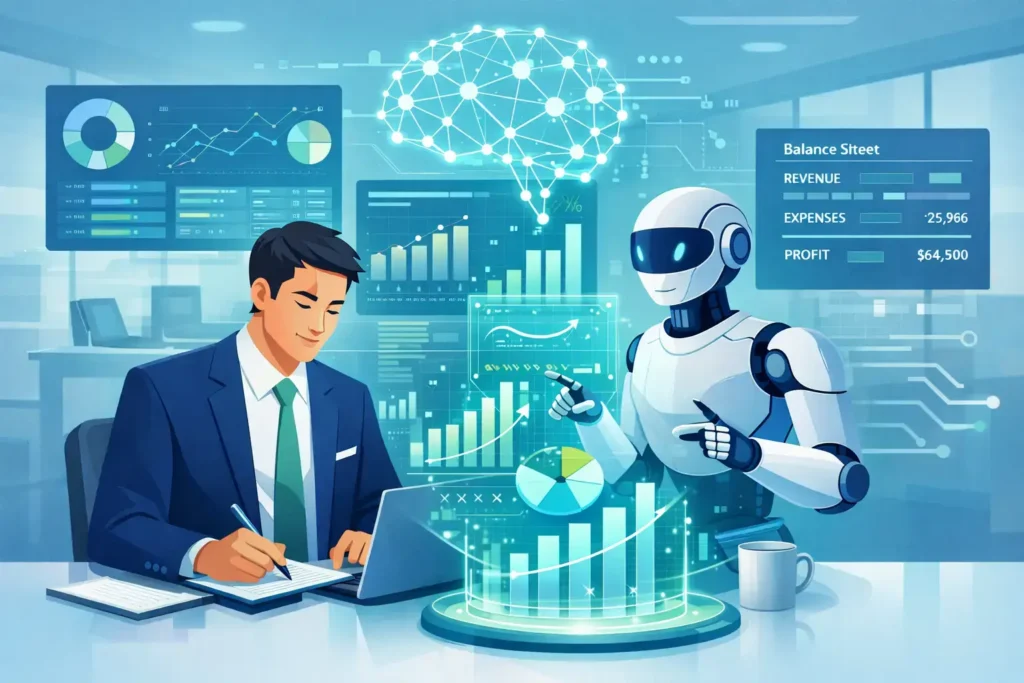
2. Human-Plus-AI Model: Leveraging Technology with Expertise
- Concept: AI handles routine, repetitive, or data-heavy tasks while humans focus on strategy, decision-making, ethics, and complex problem-solving.
- Example: A hybrid accounting team could have AI automatically reconcile 10,000 transactions per day. The human accountant then analyzes anomalies, provides recommendations to the CFO, and advises on strategic investment decisions.
- Benefit: Efficiency + insight. AI speeds up processing, humans provide judgement and context.
FAQs:Future of Chartered Accountants in AI
Will AI replace Chartered Accountants?
No. AI automates routine tasks, but human expertise, judgement, and ethical oversight remain essential.
What skills do accountants need in the AI era?
Data analysis, digital literacy, critical thinking, communication, and ethical decision-making.
How is AI changing auditing?
AI enables real-time analysis, fraud detection, and anomaly identification, enhancing audit accuracy and efficiency.
Are there new roles for accountants due to AI?
Yes. Roles include AI integration specialists, auditing experts, and data analytics professionals.
How can accountants stay relevant in 2026?
Embrace continuous learning, upskill in AI tools, and focus on value-added services like strategic advising.
Is being a CA still worth it in the AI era?
Yes. CAs who adapt to AI can focus on strategic insights and maintain a high-value role in businesses.
Final Thought:Future of Chartered Accountants in AI
The future of Chartered Accountants in AI is not about humans versus machines it’s about humans with machines. AI will automate routine tasks, analyze vast datasets, and uncover insights faster than ever, but it cannot replace the judgment, ethics, and strategic thinking that accountants bring to the table.
For CAs in 2026 and beyond, success means embracing technology while sharpening human skills: critical thinking, communication, ethical decision-making, and leadership. By upskilling in AI tools, exploring emerging roles, and staying adaptable, accountants can transform potential challenges into opportunities becoming not just number-crunchers, but strategic advisors and guardians of financial integrity.
In essence, the accountants who thrive in the AI era will be those who leverage technology to amplify their expertise, ensuring that the human touch remains at the heart of finance.
Learn more about the role of a Chartered Accountant on Wikipedia.
Financial Planning for Beginners – “Start your journey with financial planning for beginners to manage your money effectively.”