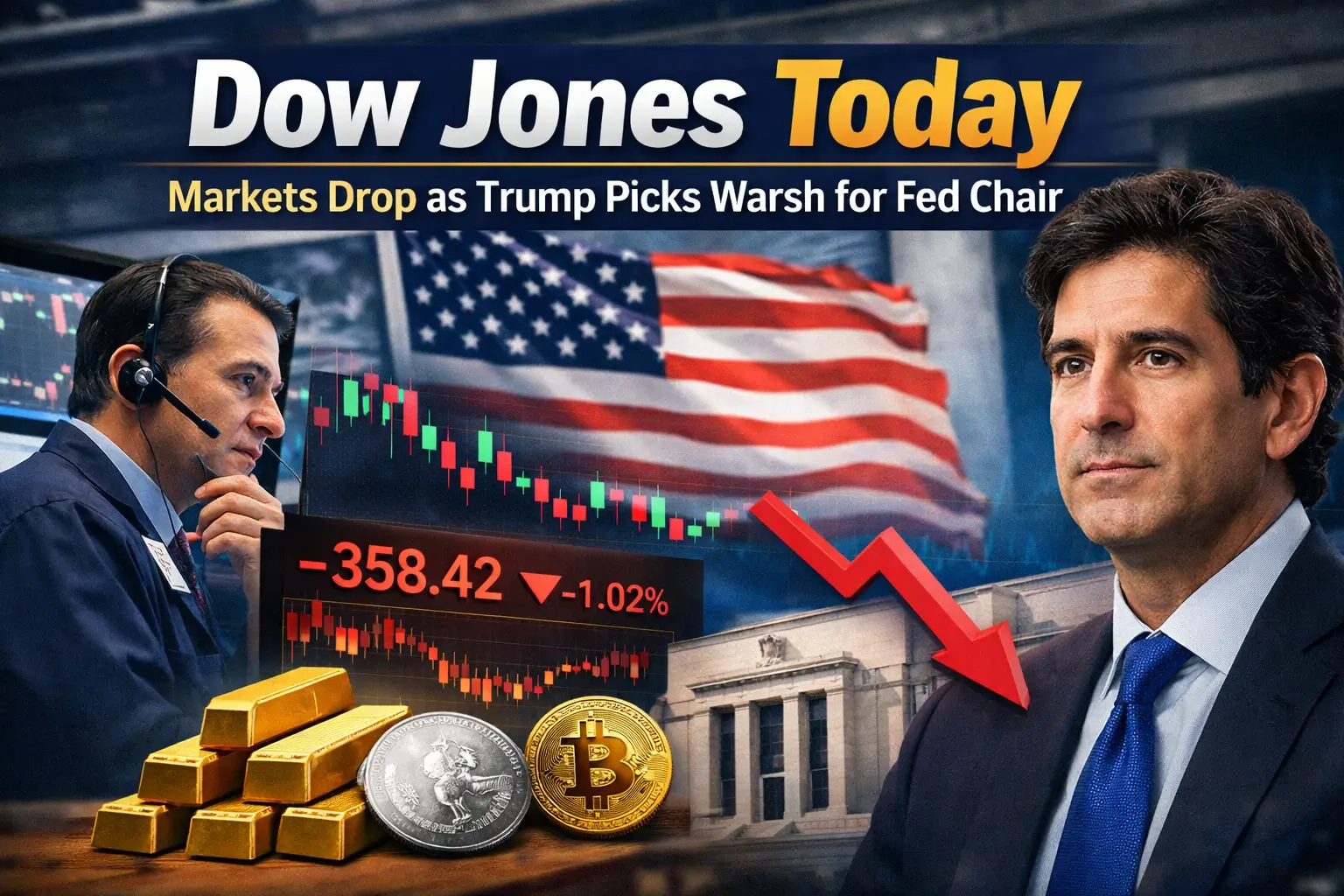
Dow Jones today Fed Chair news is driving global market attention as U.S. stock futures turn lower following reports that former President Donald Trump has tapped Kevin Warsh as the next Chair of the Federal Reserve. The announcement, expected to take effect in 2026, triggered an immediate reaction across equities, bonds, gold, and crypto as investors reassess the future path of U.S. interest rates.
In today’s fast-moving environment, Dow Jones today Fed Chair news isn’t just a headline it’s a catalyst. Markets are asking one simple question: What does this leadership change mean for rates, inflation, and asset prices? Below is a clear, beginner-friendly breakdown of what moved, why it moved, and how to think about it as an investor.
Stock Market Today — Quick Snapshot
Before diving into the “why,” here’s a clean overview of where markets stand after the Dow Jones today Fed Chair news hit screens.
Dow Jones, S&P 500, Nasdaq futures explained
U.S. stock futures slipped in early trading:
- Dow Jones futures today: Lower as industrials and financials reacted to rate uncertainty
- S&P 500 futures today: Down modestly, led by rate-sensitive sectors
- Nasdaq futures today: Weaker, pressured by Big Tech and growth stocks
Futures often move ahead of the opening bell because they reflect expectations—not final outcomes. In this case, the expectation is tighter or less predictable monetary policy under new leadership.
For many readers searching Dow Jones today Fed Chair news, the takeaway is simple: uncertainty usually equals short-term volatility.
How markets ended January 2026
January 2026 had already been a strong month for U.S. equities:
- Stocks rallied on hopes of easing inflation
- Earnings from select tech leaders exceeded expectations
- Treasury yields stabilized after a volatile 2025
That strong run left markets vulnerable to pullbacks. When the Dow Jones today Fed Chair news broke, some investors chose to lock in profits, accelerating the dip.

Table of Contents
Why Stock Futures Are Down Today (Dow Jones Today Fed Chair News )
Understanding why markets are down matters more than the size of the move. This is where Dow Jones today Fed Chair news becomes critical context.
Fed leadership uncertainty and investor reaction
The Federal Reserve Chair is one of the most powerful economic roles in the world. Even without an immediate policy change, a new nomination introduces uncertainty around:
- Future interest rate decisions
- Inflation tolerance
- Balance sheet strategy
Kevin Warsh is known for a more hawkish tone compared to some recent Fed leadership. For investors, that raises concerns about whether rate cuts could be delayed or reversed.
This is a classic “headline risk” move—markets adjusting expectations, not reacting to new data.
Earnings pressure from Big Tech stocks
At the same time, several mega-cap tech stocks faced valuation pressure:
- High price-to-earnings ratios
- Sensitivity to long-term rates
- Heavy weighting in the Nasdaq
When rate uncertainty rises, growth stocks often fall first. That’s why Nasdaq futures today underperformed broader indexes after the Dow Jones today Fed Chair news.
Who Is Kevin Warsh and Why Markets Care
For readers unfamiliar with the name, understanding Kevin Warsh helps decode the market reaction to the Dow Jones today Fed Chair news.
Kevin Warsh’s Federal Reserve background
Kevin Warsh previously served as a Federal Reserve Governor during the 2008 financial crisis. His experience includes:
- Crisis-era monetary policy
- Banking system stabilization
- Global financial coordination
Markets respect his credentials—but they also remember his skepticism toward prolonged easy money policies.
His stance on interest rates and inflation
Warsh has historically emphasized:
- Long-term inflation control
- Market discipline
- Caution around excessive stimulus
That stance matters because the Fed Chair heavily influences how aggressively the central bank responds to inflation or economic slowdowns.
This is why Dow Jones today Fed Chair news immediately rippled through rate-sensitive assets.

What a New Fed Chair Means for Interest Rates
Interest rates sit at the center of this story. For most Americans, Dow Jones today Fed Chair news ultimately matters because it affects borrowing costs.
How Fed Chairs influence borrowing costs
While the Fed Chair doesn’t act alone, they:
- Set the tone for policy discussions
- Guide market expectations
- Communicate future intentions
Even subtle language changes can move markets. If investors believe rates will stay higher for longer, yields rise—and stocks often fall.
Mortgage, loan, and credit card rate impact
Higher or uncertain rates affect everyday finances:
- Mortgages: Monthly payments increase
- Auto loans: Financing becomes more expensive
- Credit cards: Variable APRs rise quickly
To see how even small rate changes impact your budget, use tools like the Mortgage Calculator or Loan EMI Calculator to estimate monthly payments under different scenarios.
For readers tracking Dow Jones today Fed Chair news, this is where Wall Street meets Main Street.
Gold and Silver Prices Drop — What Happened?
Precious metals reacted swiftly to the Dow Jones today Fed Chair news, surprising some investors.
Why gold prices fell after hitting record highs
Gold price today USA slipped as traders reassessed the interest rate outlook. Gold typically struggles when:
- Real yields rise
- The U.S. dollar strengthens
- Rate cuts look less likely
After hitting recent highs, profit-taking accelerated once the Fed Chair news introduced uncertainty.
Is profit-taking normal in precious metals?
Yes—especially after strong rallies. Gold often moves in cycles:
- Rally on inflation fears
- Pull back on policy clarity
- Stabilize during consolidation
For beginners, short-term dips don’t necessarily invalidate gold’s long-term role as a hedge.

Treasury Yields and the U.S. Dollar Today
Bonds and currencies often tell the clearest story during Fed-related news.
Why the 10-year Treasury yield matters
The Treasury yield today 10 year rose modestly following the Dow Jones today Fed Chair news. This yield influences:
- Mortgage rates
- Equity valuations
- Global capital flows
When yields rise, future corporate profits are discounted more heavily, pressuring stock prices.
Dollar strength vs stocks and crypto
The U.S. dollar strengthened as investors sought stability. A stronger dollar can:
- Hurt multinational earnings
- Pressure commodities
- Weigh on Bitcoin and crypto
This cross-asset reaction shows how interconnected markets are during major policy developments.
These links work best inside beginner-focused sections such as “What This Means for Beginner Investors” or “Best Options for Investors Right Now”. They help readers build foundational knowledge before taking any action.
- How much should you invest monthly in the USA?
This guide helps readers understand realistic investing amounts based on income, goals, and time horizon—especially useful during volatile periods.
👉 https://moneysavingus.com/how-much-should-you-invest-monthly-in-usa/ - Dollar-Cost Averaging (DCA) beginner’s guide
Ideal to reference when explaining regular contributions and staying disciplined during Fed-driven volatility.
👉 https://moneysavingus.com/dollar-cost-averaging-beginners-guide/
Bitcoin, Oil, and Other Asset Moves Today
Beyond stocks and bonds, alternative assets reacted to the Dow Jones today Fed Chair news.
Bitcoin price reaction to Fed news
Bitcoin slipped as risk appetite cooled. While crypto is often seen as independent, it still reacts to:
- Liquidity conditions
- Rate expectations
- Dollar movements
When rates appear higher for longer, speculative assets usually face headwinds.
Oil prices and inflation expectations
Oil prices were mixed:
- Short-term pressure from stronger dollar
- Long-term support from global demand
Energy markets remain sensitive to inflation expectations, making Fed leadership changes relevant even here.
What This Means for Beginner Investors
For new investors, Dow Jones today Fed Chair news can feel overwhelming. Let’s simplify it.
Should beginners worry about daily market drops?
In most cases, no. Daily moves often reflect:
- Repositioning
- News digestion
- Short-term emotion
They rarely change long-term fundamentals overnight.
Long-term vs short-term market thinking
Successful investing focuses on:
- Time in the market, not timing
- Consistent contributions
- Diversification
If you’re unsure how much to invest regularly, see guidance on how much you should invest monthly in the USA or explore dollar-cost averaging strategies to reduce volatility risk.

How the Stock Market Historically Reacts to Fed Chair Changes
To put Dow Jones today Fed Chair news in perspective, history helps.
Past Fed Chair transitions and market behavior
Historically:
- Markets often dip on announcement
- Volatility spikes briefly
- Trends normalize once policy clarity improves
Examples show that leadership changes rarely derail long-term market growth by themselves.
Key lesson for investors
Uncertainty creates opportunity—but only for those who stay calm and informed.
Pros and Cons of Markets Reacting to Fed Chair News
Pros
- Faster price discovery
- Clearer expectations over time
- Opportunities for disciplined investors
Cons
- Short-term volatility
- Emotional trading mistakes
- Overreaction to headlines
Recognizing both sides helps investors respond rationally to Dow Jones today Fed Chair news.

Common Mistakes Investors Make During Fed-Driven Volatility
Periods of Fed-related uncertainty like today’s Dow Jones today Fed Chair news—often trigger emotional decision-making. Here are the most common mistakes investors make, and why avoiding them matters:
- Panic selling after headlines
Many investors sell immediately after breaking news, locking in losses before markets have time to digest the information. Fed headlines often cause short-term volatility, not permanent damage. - Over-trading based on speculation
Jumping in and out of positions based on rumors or predictions about future Fed actions usually leads to higher costs, poor timing, and reduced returns. - Ignoring personal time horizons
Short-term market swings matter very little if your goals are years or decades away. Reacting to daily moves can derail long-term plans.
The key lesson is simple: markets reward patience more often than prediction. Investors who stay disciplined during Fed-driven volatility tend to outperform those who react emotionally to every policy headline.
Comparison Table: Asset Reactions to Fed Chair News
| Asset Class | Typical Reaction | Risk Level |
|---|---|---|
| Stocks | Short-term volatility | Medium |
| Bonds | Yield fluctuations | Low–Medium |
| Gold | Profit-taking | Medium |
| Crypto | Sharp swings | High |
| Cash | Stability | Low |
This snapshot helps beginners visualize how Dow Jones today Fed Chair news ripples across markets.
Best Options for Investors Right Now
When markets react to major policy headlines like the recent Dow Jones today Fed Chair news uncertainty often rises faster than fundamentals change. In these moments, investors commonly shift their focus from short-term price swings to structured, long-term thinking. Without offering financial advice, the following approaches are frequently considered by investors navigating volatile conditions:
1. Diversified portfolios across asset classes
Diversification means avoiding overexposure to any single asset, sector, or strategy. Investors often look to spread risk across:
- U.S. stocks (large-cap, mid-cap, and small-cap)
- International equities for geographic balance
- Bonds and Treasuries to help stabilize portfolios during equity pullbacks
- Real assets such as gold or commodities, which may behave differently when inflation or rates shift
During Fed-driven volatility, diversification can reduce the impact of sharp moves triggered by interest rate expectations or policy uncertainty.
2. Regular contributions instead of market timing
Rather than attempting to predict short-term market direction, many investors rely on consistent investing habits. Regular contributions:
- Reduce emotional decision-making
- Smooth out purchase prices over time
- Help investors stay engaged during both rallies and pullbacks
This approach is often favored during periods when headlines, like Fed Chair changes, create daily market swings.
3. Risk-appropriate allocations based on time horizon
Market reactions mean different things depending on how soon money is needed. Investors often reassess:
- Short-term goals (1–3 years): typically require lower volatility
- Medium-term goals (3–7 years): may allow balanced exposure
- Long-term goals (10+ years): usually tolerate more short-term fluctuation
Ignoring time horizon is one of the most common mistakes during Fed-related market turbulence.
4. Cash positioning and liquidity awareness
Some investors keep a portion of assets in cash or cash equivalents to:
- Cover near-term expenses
- Avoid selling investments during downturns
- Take advantage of opportunities if markets overreact
Rising interest rates can also make cash-like instruments more attractive than in low-rate environments.
5. Using tools and calculators to model scenarios
Instead of reacting emotionally to headlines, investors often use financial tools to understand potential outcomes. For example:
- How higher interest rates affect mortgage or loan payments
- How different contribution levels change long-term portfolio growth
- How small rate shifts impact monthly budgets
Scenario modeling helps turn uncertainty into measurable possibilities, making market volatility easier to manage.
6. Staying focused on process, not predictions
Finally, experienced investors tend to emphasize discipline over forecasts. Fed policy changes, leadership transitions, and rate expectations are important—but they are only part of a much larger economic picture.
In volatile environments, clarity often comes from maintaining a consistent process rather than attempting to predict every market move. This mindset helps investors stay steady even when headlines drive short-term market reactions.
FAQs
Why are markets so sensitive to Fed-related news?
The Federal Reserve influences interest rates, liquidity, and economic expectations. Even small changes in leadership or policy signals can affect stocks, bonds, currencies, and commodities almost immediately.
Why do stock futures move before the market opens?
Stock futures trade nearly 24 hours a day and reflect investor expectations ahead of the opening bell. They often react first to breaking news, economic data, or policy developments.
Does Fed leadership change policy overnight?
No. A new Fed Chair does not change policy instantly. Markets react to expectations about future decisions, while actual policy shifts usually take time and multiple meetings.
Is volatility always a bad thing for investors?
Not necessarily. Volatility can create opportunities and improve long-term outcomes for disciplined investors who avoid emotional decision-making.
Final Thoughts: Reading Today’s Market Clearly
The reaction to Dow Jones today Fed Chair news highlights how sensitive markets are to leadership changes at the Federal Reserve. While futures dipped and volatility rose, this movement reflects uncertainty not panic.
For most investors, especially beginners, the smartest response is understanding why markets moved, not reacting emotionally. Staying informed, diversified, and focused on long-term goals remains the most reliable approach regardless of who sits in the Fed Chair.
See how interest rate changes affect your monthly payments
When markets react to Fed leadership changes, borrowing costs can shift quickly. Even small rate increases can significantly impact monthly expenses.
- Mortgage Calculator – Estimate how higher or lower interest rates affect your home loan payments
👉 https://moneysavingus.com/mortgage-calculator-estimate-monthly-payments/ - Loan EMI Calculator – Understand the real cost of personal loans, auto loans, or refinancing under different rate scenarios
👉 https://moneysavingus.com/loan-emi-calculator-what-youll-really-pay/
Disclaimer: This content is for educational purposes only and does not constitute financial advice. Market conditions change rapidly, and readers should consider their personal circumstances before making financial decisions.
The Federal Reserve, often referred to as the U.S. central bank, is responsible for setting monetary policy, managing inflation, and promoting financial stability (Federal Reserve – Wikipedia).