
Investing wisely in 2026 means balancing growth potential with risk management. Whether you are a beginner in the USA or UK, understanding which assets stocks, bonds, gold, commodities, or crypto fit your portfolio is crucial. In this guide, we explore the best investments for 2026, backed by market trends, actionable strategies, and simple examples to help you start confidently.
Before taking on new debt or financing investments, it’s wise to understand your obligations. Check how much you’ll really pay with our Loan EMI Calculator.
Market Outlook for 2026 for Best Investments for 2026
Key Economic Trends Shaping Investment Opportunities
The global economy in 2026 is expected to experience moderate growth, with central banks managing inflation carefully. Key trends include:
- Moderate interest rates: Both the US Federal Reserve and the Bank of England are maintaining cautious policies.
- Inflation watch: Inflation may stabilize, but certain sectors like energy and commodities could see price swings.
- Tech adoption: AI and automation continue to reshape industries, creating new investment opportunities.
- Geopolitical shifts: Supply chain diversification and trade policy adjustments could impact international equities.
Understanding these trends helps investors choose assets that balance growth and safety.
Interest Rates, Inflation, and Global Growth Expectations
Interest rates influence returns on bonds, savings accounts, and credit investments. For 2026:
| Asset Class | Expected Trend | Notes |
|---|---|---|
| US Treasuries | Stable to moderate yields | Safe, long-term hold |
| Corporate Bonds | Slightly higher yields | Focus on high-quality issuers |
| Equities | Moderate growth | AI & tech sectors outperforming |
| Commodities | Volatile | Energy, metals, and rare earths |
Investors should diversify across assets to hedge against inflation and interest rate changes.

Table of Contents for Best Investments for 2026
Equities: Where to Find Value in a High-Priced Market for Best Investments for 2026
Stocks remain a cornerstone of any portfolio. The key is balancing growth with value and diversifying across sectors and geographies.
Tech Stocks and AI Investments: Risks and Opportunities
AI and tech-focused equities are high-growth but volatile. Examples include:
- US mega-cap tech: Companies like Microsoft or Alphabet are stable but expensive.
- AI-driven ETFs: Offer exposure without overconcentration.
Pros: High upside potential, innovation-driven growth
Cons: Price swings, regulatory risks
Example: Investing $500 in a tech ETF could grow 8–12% annually, but could also drop 10–15% in a market correction.
Undervalued Sectors for Beginners
Beginner investors should consider:
- Consumer staples
- Utilities
- Healthcare
These sectors tend to be less volatile while offering steady returns. Fractional shares and ETFs make it easier to diversify even with small investments.
Diversifying Globally: Emerging Markets and Asia
Emerging market equities provide growth opportunities outside the US and UK. Countries like South Korea, Taiwan, and parts of Southeast Asia are attracting foreign investment.
Tip: Allocate no more than 15–20% of your equity portfolio to emerging markets to balance risk.
Fixed Income Strategies: Cash, Bonds, and Municipals for Best Investments for 2026
Why Cash Isn’t Always Safe
While holding cash seems secure, inflation can erode purchasing power. In 2026, a savings account yielding 2% may not keep pace with 3% inflation.
High-Quality Bonds and Laddering Strategies
Bond laddering involves buying bonds with staggered maturities. This strategy:
- Reduces interest rate risk
- Provides consistent income
- Offers flexibility to reinvest
Example: Laddering $10,000 across 1-, 3-, and 5-year bonds can yield stable returns while keeping capital accessible.
Municipal Bonds for Tax-Efficient Returns
US investors can consider muni bonds for tax advantages. UK investors have similar options in gilts and corporate bonds with tax-efficient wrappers.
Pros: Tax efficiency, stability
Cons: Lower yield than high-risk alternatives
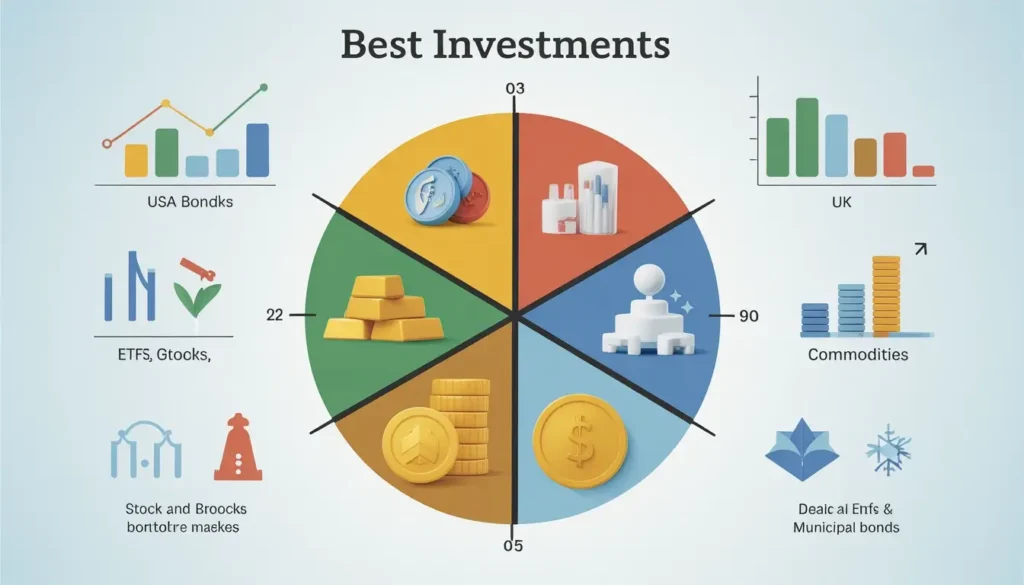
Gold, Commodities, and Real Assets for Best Investments for 2026
Gold as a Hedge Against Inflation
- What it means: Gold is a precious metal that has retained value for centuries. Unlike cash or bonds, its price tends to rise when inflation increases because it’s a tangible asset with limited supply.
- Portfolio strategy: Allocating 5–10% of your portfolio to gold can act as a buffer during market downturns or inflationary periods.
- Example: If your total investment portfolio is $20,000, investing $1,000–$2,000 in gold can help preserve value if other assets like stocks temporarily decline.
Why it works: Gold doesn’t generate interest like a bond, but its scarcity and global demand make it a safe haven in uncertain economic times.
Commodities Linked to AI and Infrastructure
- What it means: Commodities are raw materials like metals and energy resources. Some, like copper, lithium, and rare earth elements, are critical for technology and infrastructure projects such as electric vehicles, AI servers, and renewable energy.
- How beginners invest: Buying physical commodities is complex, so beginners usually invest via:
- Commodities ETFs – Funds that track the price of metals or a basket of resources.
- Mutual funds – Managed portfolios investing in commodity-producing companies.
- Example: Investing $500 in a lithium-focused ETF exposes you to companies mining lithium for batteries without physically buying the metal.
Why it matters: As AI and green infrastructure grow, demand for these metals may rise, potentially boosting returns.
Crypto for Cautious, Younger Investors for Best Investments for 2026
- What it means: Cryptocurrency is a digital asset (like Bitcoin or Ethereum). It can diversify a portfolio because its performance doesn’t always correlate with traditional markets.
- Risk: Crypto is extremely volatile prices can swing 20–30% in a few weeks.
- Strategy for beginners: Limit exposure to 2–5% of total portfolio. Start with well-known coins (Bitcoin, Ethereum) or regulated stablecoins to reduce risk.
- Example: For a $10,000 portfolio, investing $200–$500 in crypto provides potential growth without overexposing you to risk.
Why it works: Small allocations allow investors to benefit from potential upside while protecting the majority of their capital.
Cryptocurrency can diversify a portfolio but is highly volatile. Read more about cryptocurrency and how it works.

Credit Markets and Private Lending Opportunities ( Best Investments for 2026 )
Understanding Credit Risk and Reward
- What it means: Credit markets involve lending money to companies or individuals. Investors earn interest, but risk defaults if borrowers fail to pay.
- Opportunity: Private loans or corporate bonds often pay higher yields than government bonds, compensating for additional risk.
- Strategy: Diversify across borrowers, industries, and types of credit to reduce risk.
Payment-in-Kind (PIK) and Shadow Defaults
- PIK loans: Instead of paying cash interest, the borrower adds it to the loan balance. This increases risk during downturns because you don’t receive cash immediately.
- Shadow defaults: Situations where companies are technically paying obligations but may not have strong financial health. Understanding these helps investors avoid hidden risks.
Example: Investing $1,000 in a PIK bond may grow to $1,100 over a year if the company pays interest in debt rather than cash but if the company struggles, repayment may be delayed or lost.
Flexible Credit Strategies
- Balanced approach: Mix public bonds (government/corporate), private lending, and credit ETFs to balance risk vs reward.
- Why: It allows higher yields without concentrating risk in a single borrower or loan type.
How to Build a Beginner-Friendly Investment Portfolio for Best Investments for 2026
Asset Allocation Guidelines (Rule of 110)
- Rule of 110: A simple formula to determine equity exposure based on age:
- Equity allocation = 110 – your age
- Example:
- Age 30 → 80% equities, 20% fixed income
- Age 50 → 60% equities, 40% fixed income
- Why it matters: Younger investors can take more risk with stocks for growth; older investors shift to safer bonds to protect capital.
Combining Stocks, Bonds, and Alternative Assets
A beginner-friendly 3-asset allocation:
| Asset Type | Allocation Example | Notes |
|---|---|---|
| Equities | 60% | Global + emerging markets exposure |
| Bonds & Cash | 30% | Laddered bonds, short-term cash |
| Alternatives | 10% | Gold, commodities, crypto |
Example: For a $10,000 portfolio:
- $6,000 in diversified equities
- $3,000 in bonds or cash
- $1,000 in gold, commodities, or crypto
This balances growth, income, and protection.
While bonds provide long-term growth, a portion of your portfolio in cash can offer flexibility. Explore the Best Regular Savings Accounts in the UK to maximize short-term returns safely.
Avoiding Common Mistakes in Investing (Best Investments for 2026 )
1. Chasing Hype
- What it means: Many investors get excited by “hot stocks” or trending sectors without understanding the fundamentals. This is often driven by social media, news headlines, or word-of-mouth tips.
- Why it’s risky: Stocks that suddenly surge in popularity can be extremely volatile. Buying at the peak can lead to losses when the hype fades.
- Example: In 2021, some “meme stocks” skyrocketed due to social media buzz. Investors who bought at the top often faced steep declines shortly after.
- Tip for beginners: Focus on companies or ETFs with strong fundamentals and a long-term growth strategy. Always do research and avoid making decisions solely based on hype.
2. Overconcentration
- What it means: Putting too much money into a single stock, sector, or asset type increases risk. If that investment underperforms, your entire portfolio suffers.
- Why it’s risky: Even top-performing stocks can experience sudden declines. Diversification reduces exposure to any single point of failure.
- Example: If 50% of your portfolio is invested in tech stocks and the tech sector drops 20%, your overall portfolio loses 10% immediately.
- Tip for beginners: Spread investments across different asset classes—equities, bonds, real assets like gold, and alternative assets like crypto. Use ETFs or index funds to achieve diversification easily.
3. Ignoring Fees and Taxes
- What it means: Every investment may have fees (management fees, trading commissions) or tax implications that reduce net returns. Ignoring them can silently erode your portfolio over time.
- Why it’s risky: High fees can eat into compounding growth, and poor tax planning may trigger unnecessary liabilities.
- Example: Investing $10,000 in a fund with a 2% annual management fee reduces growth significantly compared to a 0.3% low-cost ETF over 10 years. Similarly, failing to consider capital gains taxes can reduce profits when you sell stocks.
- Tip for beginners:
- Choose low-cost ETFs or mutual funds.
- Be aware of tax-advantaged accounts: 401(k), IRA (USA) or ISA, SIPP (UK).
- Plan for long-term holding to minimize frequent trading costs.
Planning for large purchases like a home requires understanding your monthly commitments. Use our Mortgage Calculator to estimate monthly payments and plan your portfolio accordingly.

Step-by-Step Action Plan (Best Investments for 2026)
Investing in 2026 doesn’t have to be complicated, even for beginners. By following a structured approach, you can build a diversified, resilient portfolio that balances growth and risk.
1. Opening a Brokerage or Investment Account (USA & UK)
Before you invest, you need a brokerage account. This is where you buy and manage your investments.
- USA: Platforms like Robinhood, Fidelity, and Vanguard are beginner-friendly, low-cost, and offer access to stocks, ETFs, bonds, and mutual funds. Robinhood is popular for small, frequent investments and fractional shares. Fidelity and Vanguard provide robust research tools and retirement account options.
- UK: Platforms such as Hargreaves Lansdown and Interactive Investor are regulated, secure, and offer a wide selection of UK and international stocks, ETFs, and funds. Hargreaves Lansdown is beginner-friendly with strong educational resources, while Interactive Investor is suitable for those planning to invest larger amounts with flat monthly fees.
Tips for beginners:
- Compare fees, account minimums, and available tools.
- Decide if you want a taxable account or a tax-advantaged account (IRA/401(k) in the US, ISA/SIPP in the UK).
- Start small and gradually increase contributions as you become comfortable.
2. Selecting ETFs, Stocks, and Fractional Shares
Once your account is open, choosing the right investments is key.
- ETFs (Exchange-Traded Funds): These funds pool multiple stocks or bonds in one investment. They reduce risk because you’re not relying on a single stock. For example, a S&P 500 ETF gives exposure to 500 large US companies at once.
- Fractional shares: Some stocks are expensive (e.g., Amazon or Alphabet). Fractional shares let you invest small amounts—say $50 or $100—without buying a full share.
- Dividend funds: These funds focus on companies that regularly pay dividends. Reinvesting dividends compounds your wealth over time and provides steady income.
Example Calculation:
Investing $100 monthly in a balanced ETF portfolio with an average 7% annual return could grow to roughly $15,000 over 10 years. If you increase contributions to $200 per month, the same portfolio could reach $30,000. This illustrates the power of consistency and compounding.
3. Automating Investments for Long-Term Growth
Automation is one of the most effective ways to grow your wealth:
- Set up recurring contributions from your bank account to your investment account.
- Use automatic reinvestment of dividends for compounding.
- Schedule quarterly rebalancing to maintain your target asset allocation.
Why it works: Automation removes emotional decisions, prevents missed opportunities, and ensures consistent growth, even if markets fluctuate.
By following this step-by-step approach, beginners in the USA and UK can confidently start investing in 2026, build diversified portfolios, and steadily grow wealth over time.
FAQ: Best Investments for 2026
Q1: What are the best investments for 2026?
A1: Diversified portfolios with equities, bonds, gold, commodities, and small crypto allocations are suitable for resilience and growth.
Q2: How much should beginners invest in stocks in 2026?
A2: Start small, even $100 or £100, and invest consistently using ETFs or fractional shares.
Q3: Should I invest in bonds or keep cash in best investments for 2026?
A3: Bonds offer better long-term returns and diversification; cash is safer short-term but loses purchasing power during inflation.
Q4: Are AI and tech stocks safe to invest in for 2026?
A4: They offer growth potential but should only be a part of a diversified portfolio.
Q5: Can gold and commodities protect my portfolio?
A5: Yes, modest allocations can hedge inflation and reduce overall portfolio volatility.
Q6: What’s the best way to diversify a beginner portfolio?
A6: Spread investments across equities, bonds, and alternative assets like gold or crypto, and use ETFs for simplicity.
Conclusion: Best Investments for 2026
- Diversify across asset classes: Equities, bonds, gold, crypto.
- Stay informed: Follow economic trends, interest rates, and sector growth.
- Avoid emotional investing: Stick to your allocation and long-term plan.
- Use beginner-friendly tools: ETFs, calculators, fractional shares for simplicity.
With this approach, investors in the USA and UK can create resilient, growth-oriented portfolios that balance risk and reward in 2026.
Disclaimer: Educational purposes only. Not financial advice. Consult a licensed professional before investing.
ETFs are a great way to reduce risk by pooling multiple stocks into a single investment. Learn more about Exchange-Traded Funds on Wikipedia.
Beginners can start small and increase contributions over time. Learn how to calculate your ideal monthly investment in the USA with our guide: How Much Should You Invest Monthly in USA.