
Intro: Best Cheap Car Insurance in USA 2026
Car insurance in America is expensive — and confusing. The national average for full coverage now sits at around $208 per month, or roughly $2,496 per year. But here’s what most drivers don’t know: the same driver profile can produce quotes that vary by $500 or more per year depending on which company you choose. That gap is money sitting on the table.
The good news? After rate hikes of 17% in 2024 and nearly 8% in 2025, prices are finally stabilizing. Car insurance costs are expected to rise by less than 1% in 2026 — which means right now is one of the best moments in years to shop around and lock in a better deal.
This guide covers the best cheap car insurance companies in the USA for 2026, with real rates, coverage breakdowns, state-by-state comparisons, and actionable tips to lower your premium today.

Table of Contents
Read More about Best Budgeting Apps USA 2026.
Quick Comparison: Cheapest Car Insurance Companies USA 2026
| Company | Min. Coverage/mo | Full Coverage/mo | Best For | All 50 States? |
|---|---|---|---|---|
| USAA | ~$43 | ~$141 | Military families | ❌ Military only |
| GEICO | ~$40–$43 | ~$97–$130 | Most drivers | ✅ |
| Travelers | ~$45 | ~$122–$139 | Best overall value | ✅ |
| Auto-Owners | ~$46 | ~$125 | Midwest/Southeast | ❌ 26 states |
| American Family | ~$50 | ~$135 | Midwest families | ❌ 19 states |
| State Farm | ~$55 | ~$150 | Local agent users | ✅ |
| Progressive | ~$57 | ~$155 | High-risk drivers | ✅ |
| Nationwide | ~$58 | ~$145 | Low-mileage drivers | Most states |
Rates from NerdWallet, MoneyGeek, The Zebra, and Experian — May/June 2026. Your quote will vary.

Best Cheap Car Insurance Companies Reviewed
1. USAA — Cheapest Overall
If you qualify, USAA is the single cheapest car insurance option in the USA. U.S. News puts its average annual rate at just $1,489 — well below any nationally available competitor. Minimum coverage averages $43/month; full coverage around $141/month. On top of price, USAA consistently tops customer satisfaction rankings and offers military-specific perks: garaging discounts, gap insurance, and a usage-based program that rewards safe driving.
The only limitation: USAA is available exclusively to active military members, veterans, and their eligible family members.
Best for: Active military, veterans, and immediate family members.
| ✅ Pros | ❌ Cons |
|---|---|
| Lowest average rates in the USA | Military eligibility required |
| Top customer satisfaction scores | No local agent offices |
| Military-specific discounts and perks | Not available to general public |
2. GEICO — Cheapest for the General Public
For everyone who doesn’t qualify for USAA, GEICO is the most consistently affordable car insurance company available to all Americans in all 50 states. NerdWallet cites a minimum coverage average of just $40/month, while MoneyGeek puts full coverage at around $97–$130/month depending on your profile.
GEICO operates almost entirely online — no local agent network — which keeps overhead low and rates competitive. It offers one of the longest discount lists of any insurer, including savings for federal employees, good students, military members, and safe drivers enrolled in its DriveEasy telematics program.
Best for: Most drivers who want the lowest available rate without eligibility restrictions.
| ✅ Pros | ❌ Cons |
|---|---|
| Cheapest widely available insurer | No local agents for in-person help |
| Available in all 50 states | DriveEasy can raise rates for risky driving |
| Longest discount list among major insurers |
3. Travelers — Best Overall Value
Travelers earns the top spot on NerdWallet’s Best Car Insurance Companies of 2026 list and U.S. News’ best overall rating. Among insurers open to all Americans, it offers the cheapest full coverage — starting at $122/month — with minimum coverage averaging around $45/month. The combination of competitive pricing, solid customer service, and a well-rounded set of optional coverages makes Travelers the best all-around pick for non-military drivers. Its IntelliDrive telematics program rewards safe drivers with meaningful discounts.
Best for: Non-military drivers wanting the best balance of price and quality.
| ✅ Pros | ❌ Cons |
|---|---|
| Cheapest full coverage among national insurers | IntelliDrive can increase rates for risky drivers |
| Top-rated by NerdWallet & U.S. News 2026 | Fewer local agents than State Farm |
| Strong optional coverage selection |
4. Progressive — Best for High-Risk Drivers
Had an accident or a speeding ticket? Progressive is the most forgiving major insurer when it comes to drivers with incidents on their record. Its Snapshot telematics program also gives higher-risk drivers a real opportunity to earn lower rates through demonstrated safe behavior going forward.
For young adults (age 20) getting their own policy, NerdWallet identifies Progressive as the cheapest large insurer in the country at an average of $297/month for full coverage. It also offers ride-share coverage for Uber and Lyft drivers — something not all competitors provide.
Best for: Drivers with violations, young adults on their own policy, and gig workers.
| ✅ Pros | ❌ Cons |
|---|---|
| Most forgiving rates for high-risk profiles | Higher rates for clean-record drivers vs. GEICO/Travelers |
| Best large insurer for young adults | Snapshot can raise rates for unsafe driving |
| Ride-share coverage available |
5. State Farm — Best for Local Agent Access
State Farm is the largest car insurer in the USA with a massive local agent network. Full coverage averages ~$150/month, slightly above GEICO and Travelers — but State Farm is expected to cut rates by around 4% in 2026, making it increasingly competitive. If in-person support matters to you, State Farm is the right call.
Best for: Drivers who prefer face-to-face help at renewal and claims time.
6. Nationwide — Best for Low-Mileage Drivers
Nationwide’s SmartMiles pay-per-mile program charges a low base rate plus a small per-mile fee — ideal if you drive under 8,000–10,000 miles per year. It also offers a vanishing deductible that drops $100 for every clean year, rewarding safe drivers over time.
Best for: Remote workers, retirees, and light drivers who want to pay for only what they use.
Coverage Types: What You’re Actually Paying For
| Coverage Type | What It Covers | Avg. Monthly Cost | Required? |
|---|---|---|---|
| State Minimum / Liability | Damage/injuries you cause others | ~$50–$60 | Yes — all states |
| Full Coverage | Liability + collision + comprehensive | ~$195–$244 | If leased or financed |
| Collision | Your car in any crash | Add-on | No |
| Comprehensive | Theft, weather, vandalism, animals | Add-on | No |
| Uninsured Motorist | Accidents caused by uninsured drivers | Add-on | Required in ~half of states |
| Gap Insurance | Covers loan balance on totaled car | ~$20–$40 | Optional |
| PIP (Personal Injury) | Medical costs regardless of fault | Varies | Required in 12 states |
Quick rule: If your car is paid off and worth under $5,000, liability-only could make more financial sense than full coverage. If it’s leased, financed, or newer, full coverage is almost always the right call.
Car Insurance Rates by Age Group 2026
Your age is one of the biggest pricing factors in car insurance. Here’s what American drivers pay on average:
| Age Group | Full Coverage/mo | Min. Coverage/mo | Key Tip |
|---|---|---|---|
| 16–17 | $560–$866 | $280–$436 | Stay on parents’ policy to save |
| 18–19 | $400–$550 | $180–$280 | Clean record is critical |
| 20–24 | $250–$330 | $100–$150 | Good student discount applies |
| 25–29 | $165–$210 | $65–$85 | Rates drop significantly at 25 |
| 30–55 | $130–$180 | $50–$65 | Lowest rates — best window to lock in savings |
| 56–65 | $155–$200 | $55–$70 | Senior discounts start here |
| 65+ | $190–$240 | $70–$90 | Mature driver course discounts help |
Sources: Experian, CarInsurance.com, MoneyGeek — June 2026.
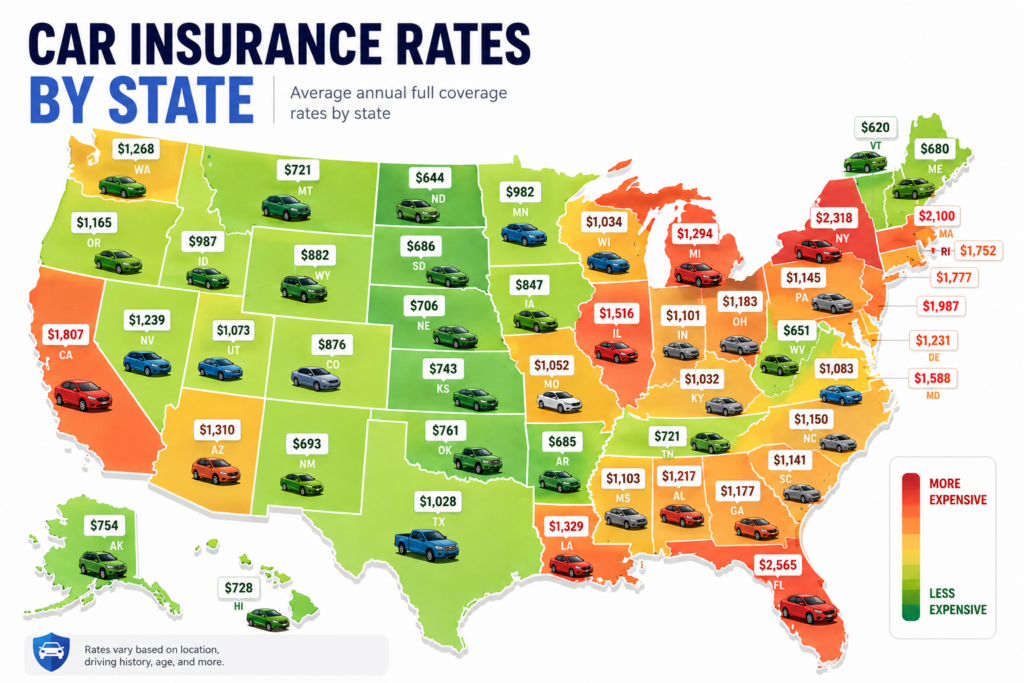
Cheapest & Most Expensive States for Car Insurance 2026
Where you live can swing your premium by hundreds of dollars per month.
| Cheapest States | Avg. Full Coverage/mo | Most Expensive States | Avg. Full Coverage/mo |
|---|---|---|---|
| Vermont | $117 | Maryland | $352 |
| New Hampshire | $127 | Connecticut | $325 |
| Maine | $142 | Nevada | $300+ |
| Wyoming | ~$133 | Florida | $300+ |
| Idaho | ~$135 | Louisiana | $300+ |
Vermont’s rural roads, low crime, and low accident rates keep it the most affordable state in the country. Maryland, Connecticut, Nevada, Florida, and Louisiana sit at the top due to traffic density, fraud rates, extreme weather exposure, and strict minimum coverage laws.
Sources: Experian, ValuePenguin, The Zebra — 2026.
8 Ways to Get Cheap Car Insurance in the USA Right Now
1. Compare 3–5 quotes every year. The same driver can see $500+ in annual rate differences between insurers. This single step saves more than anything else.
2. Raise your deductible. Going from $500 to $1,000 can cut full coverage premiums by 10–15%. Only do this if you can absorb the out-of-pocket cost after a claim.
3. Bundle home and auto. Most insurers offer 5–17% off when you insure both home (or renters) and car with the same company.
4. Enroll in telematics. Programs like GEICO’s DriveEasy, Progressive’s Snapshot, and Travelers’ IntelliDrive reward safe drivers with 10–30% off — based on real driving data, not just your age.
5. Ask about every discount. Good student, military, multi-car, low-mileage, auto-pay, paperless billing — the list varies by insurer. Most customers never ask; most insurers never volunteer.
6. Drop collision/comprehensive on older cars. If your car is worth under $4,000–$5,000 and fully paid off, full coverage may cost more annually than the car is worth.
7. Improve your credit score. In most U.S. states, insurers use a credit-based insurance score. Moving from fair to good credit can reduce premiums by 15–30%.
8. Consider pay-per-mile insurance. Nationwide SmartMiles and similar programs are ideal for drivers doing under 8,000 miles per year — potentially saving 20–40% vs. standard rates.
Final Verdict
The best cheap car insurance in the USA for 2026 depends entirely on who you are and where you live — but the framework is simple:
- Military or veteran? Start and likely end with USAA.
- Clean record, want the lowest rate? Compare GEICO and Travelers first.
- Had an accident or ticket? Progressive is the most forgiving on pricing.
- Prefer a local agent? State Farm is your best affordable option.
- Drive under 8,000 miles/year? Look hard at Nationwide SmartMiles.
- In a 26-state Auto-Owners or 19-state AmFam footprint? Regional insurers often beat national brands.
The golden rule: never auto-renew without comparing at least two or three quotes. With rates stabilizing in 2026, switching — or simply threatening to switch — is one of the most effective money-saving moves an American driver can make this year.

Rates and data sourced from NerdWallet, The Zebra, MoneyGeek, Experian, ValuePenguin, and U.S. News — May/June 2026. Individual rates vary by driver profile, ZIP code, vehicle, and coverage selection. Always get personalized quotes before purchasing.
Read More about Car Insurance on Wikipedia